Chapter 3 · Sophie's Recital
Stairs she should not be afraid of. A daughter who reaches back.
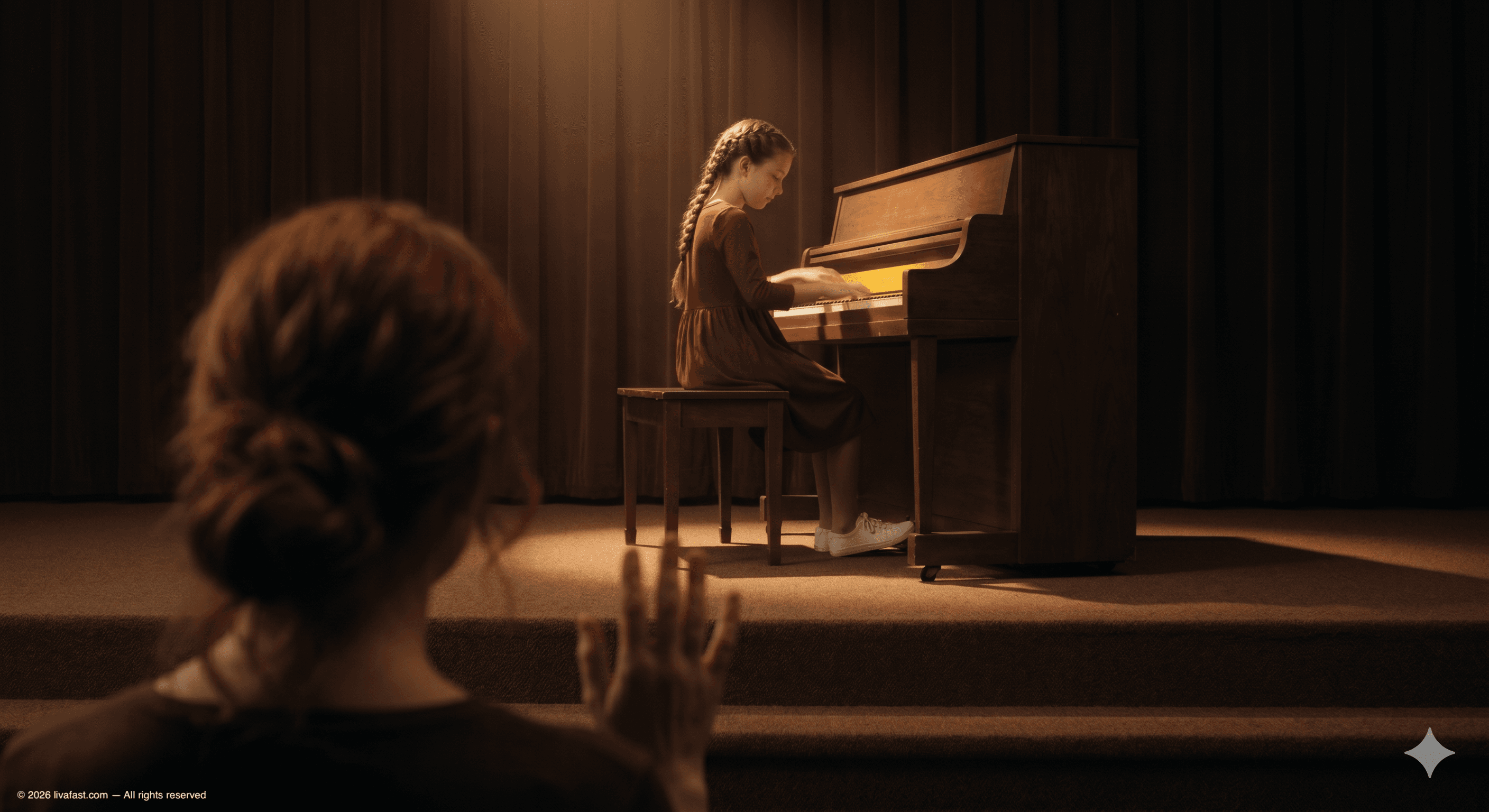
The auditorium of the Lakeshore Elementary School was a rectangular room with brown carpet, a low stage, a piano with one yellowing key, and a great many parents who had run from work in clothes that did not quite match. Ellie was one of these parents. She had come straight from the studio, had not thought to change, had a fleck of green watercolor on the back of her left hand, and was — at six thirty-two on a Thursday in late October — climbing the stairs to the second-tier seats in the back, because the first-tier seats were full and because, in a way she could not quite admit, she did not want to be seen.
The stairs were not many. Twelve. She had climbed them a hundred times. She had climbed them carrying Sophie on her hip when Sophie was four, climbed them carrying art supplies for the school auction, climbed them on a Saturday in the rain to vote.
Tonight, on the seventh stair, her chest tightened.
She paused. Pretended to look at her phone. Smiled, vaguely, at a father who was passing her on the way down. Climbed two more stairs. Paused again. Her heart was making a sound in her ears she did not recognize, a small, fast, rabbit's drum. There was a tightness across her shoulders. There was a faint, sour taste in the back of her throat.
She made it to her seat. She sat down heavily and put her bag on her lap and opened her phone as if she were checking a message, although she was checking nothing — she was only trying to give her face something to do while she listened to her own breathing.
A mother she vaguely recognized leaned over from the next seat. "You okay? You look pale."
"I ran from the parking lot," Ellie lied. "I'm fine. Thank you."
The lights dimmed. The music teacher, a small, tireless woman named Mrs. Quintero, walked onto the stage in a glittering black blouse and lifted her hands to quiet the room. Children, in graduated sizes, came out one at a time. Ellie tried to focus. She could feel the rabbit's drum slowing, slowly. She could feel the sweat at the back of her neck. Stairs, she thought, dazed. Twelve stairs.
Sophie was the seventh performer. She walked out in her good red dress and her sneakers, which she had refused to trade for the patent-leather flats Ellie had laid out that morning, and she sat at the piano with the small, ferocious concentration she brought to every difficult thing in her life. She played a piece called Solfeggietto by C.P.E. Bach — fast, intricate, the right hand and the left hand chasing each other up and down a ladder of sixteenth notes. Sophie made one mistake, in the middle, and recovered without flinching, and finished, and stood, and bowed, and looked into the dark of the auditorium for her mother.
Ellie raised her hand. Sophie saw her. Sophie smiled.
The smile was so unguarded — so private, so meant for her — that Ellie's chest tightened again, but differently this time. Not the rabbit's drum. The other thing. The deeper thing. The I am her mother and she is my whole life thing. She felt tears come up and did not let them fall.
After the recital, in the lobby, Sophie ran to her with the speed of a child who has played seven minutes of Solfeggietto without crying. Ellie knelt — and felt, in the kneeling, the difficulty of it, the small, embarrassing effort of bringing her body down toward her own daughter — and she opened her arms and said, "You were brilliant."
"I missed the F-sharp."
"I didn't notice."
"You did."
"I didn't, peanut. I was crying."
Sophie pulled back. Studied her face. "Why?"
"Because I love you and you played beautifully and that's what mothers do."
Sophie accepted this. She took her mother's hand. They walked together toward the parking lot. The October air was sharp. The maples were dropping, dropping, dropping. Sophie was talking about the boy who had played after her, who had played a piece she did not consider very difficult, but I clapped for him because Mrs. Quintero says we always clap, and Ellie was nodding and listening and not listening, because beneath her ribs, the ache had begun again, and on her left, the soft skin where her bra strap had been, there was a wet patch of sweat she had not noticed inside the building.
In the car, before she turned the key, Sophie looked at her — that long, serious, ten-year-old look — and said, "Mom."
"Yeah, peanut."
"You walked up the stairs really slow."
Ellie did not answer.
"Are you sick?" Sophie said.
There was a long silence in the car. Ellie put her hands on the steering wheel. She thought about lying. She thought about laughing it off. She thought about how Sophie was ten, and how children at ten could hold the truth, and how children at ten could also be broken by the wrong kind of truth, told too soon.
"I think I'm just tired, peanut," she said at last. "I'm going to make a doctor's appointment. Just to be sure."
"When?"
"Tomorrow."
"Promise?"
"Promise."
They drove home in the dark. Sophie hummed Solfeggietto under her breath. Ellie made the promise into a small, hard stone in her pocket, and she carried it home, and the next morning, before her own courage could fail her, she called the office of her primary care doctor at eight-oh-one and made an appointment for the following Monday.
When she hung up, she sat for a long moment on the edge of her bed, holding the phone, and felt — beneath her ribs — the dull, faithful ache, and felt, beneath that, something new: the small, terrified certainty that the body she had been ignoring had just been heard, for the first time, by the only person who could hear it.
Track this in LivaFast
Your FIB-4 score updates automatically from your labs.