Chapter 15 · Sugar Withdrawal
A headache that lasts four days. An apology to a ten-year-old.
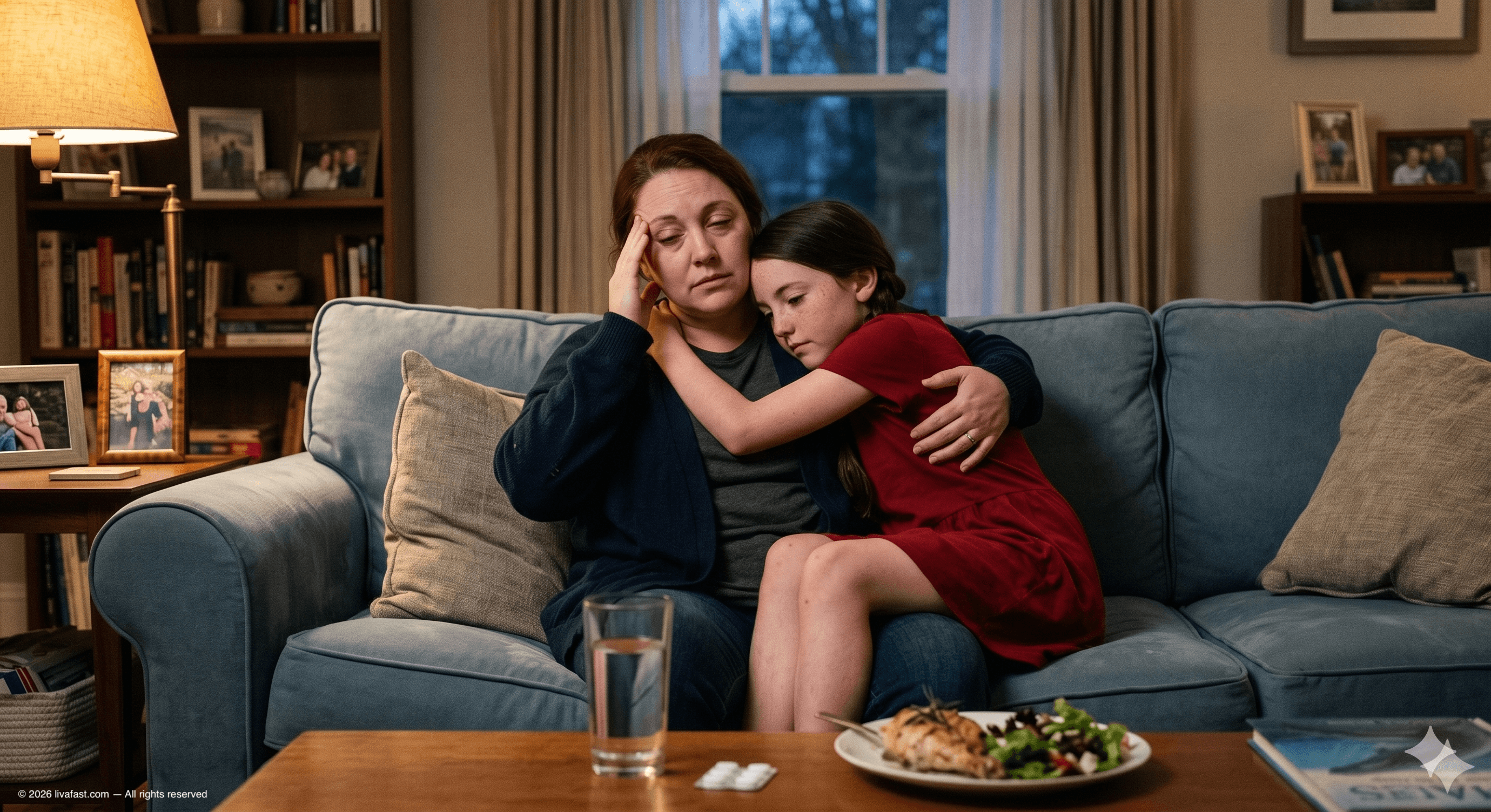
The headache started on a Wednesday morning in the third week.
It started behind her left eye, small and tight, like a pebble pressed against the inside of her skull. By ten in the morning, it was a bigger pebble. By noon, it was a stone. By four in the afternoon, it was a fist. She drank water. She drank more water. She took two ibuprofen. She lay down on the studio couch with a cold paper towel over her eyes, and she sent Sam a one-line Slack message that said migraine, going dark for an hour, and she closed her eyes.
She did not have a migraine. She knew, somewhere underneath the pain, what was happening. She had been doing some reading. The body that has been fed sugar three times a day for fifteen years — the body that has been bathed, hourly, in fructose and sucrose and the soft, cheap rivers of refined carbohydrate — does not, when the rivers stop, simply nod its head and continue. It revolts. It grieves. It mourns, with great, dramatic theater, the absence of the one chemical it had grown accustomed to expecting.
Ellie's body was mourning.
By that night, she was irritable in a way she had not been since Sophie was a colicky infant. She snapped at the man at the corner store — No, just water, just the water, please don't put it in a bag. She snapped at a colleague over Slack, and had to apologize. She snapped at Sophie, twice, at dinner — once because Sophie had asked, three times, whether she could have a popsicle, and once, for no reason at all, because Sophie had said she didn't like the rosemary on the chicken.
Sophie went very quiet at the table.
"I'm sorry, peanut."
"It's okay."
"It's not okay. I shouldn't have snapped at you. My head hurts."
"I know."
"I'm sorry."
"Mom."
"Yeah."
"Can I sit on your lap for a minute?"
Sophie was ten, and Sophie had not asked to sit on her lap in a year, and the question hit Ellie like a wave.
"Yes," Ellie said. "Yes. Come here, peanut."
Sophie climbed onto her lap — too big for it, technically, but children make themselves the right size for what they need — and put her head against her mother's shoulder. Ellie put both her arms around her daughter. She felt the small, warm weight of her own child against her own bad mood, and she let, again, the not-quite-crying that had become, in this new life, a kind of regular punctuation.
"I'm sorry I'm cranky, peanut."
"It's the sugar."
"Yeah."
"The app told you that, right?"
"It did."
"It said it would be hard for the first week or two."
"How do you know what the app said?"
"You read it out loud sometimes. When you don't know I'm listening."
Ellie laughed — laughed, again, in the small, surprised way that, lately, had begun to break loose in her without warning — and hugged her daughter tighter.
"You're a snoop."
"I'm a kid."
"Same thing."
The headache lasted four days.
On the second day, Beatriz, on her porch, took one look at Ellie's face as she walked past the bench and called, "Mi'ja, are you off the sugar?"
"How did you know."
"You look like you have lost your dog, mi'ja. Hector looked like that for a week. I made him drink hot bone broth with a little salt and lemon every afternoon. You come tonight at six. I will give you some. I have a big pot."
"Beatriz —"
"You come."
She went. Beatriz lived in a small first-floor apartment with brown carpet, a faded green couch, fifty-six photographs of grandchildren and great-grandchildren on every flat surface, and a kitchen so warm and steamy from the bone broth on the stove that Ellie's glasses fogged when she walked in. Beatriz handed her a mug.
"Drink slowly," Beatriz said.
The broth was clear, gold-colored, salty in a careful way, with a curl of fresh lemon zest on the surface. Ellie had not eaten broth in years that had not come out of a box. She sat on Beatriz's couch and drank it slowly, and Beatriz, in the kitchen, at the stove, talked about Hector. About the way he had laughed, before. About the way he had refused to walk, after. About how, in the end, after he had died, she had cleaned out his closet, and the only thing she could not throw away was a fishing hat that he had worn for thirty years and that still smelled, faintly, of the sea.
"I wear it sometimes," Beatriz said, "in the apartment, in the morning, when nobody can see. I am an old woman in an old hat. Está bien."
By the third day, the headache was a dull echo. By the fourth day, it was gone. On the fifth day — a Saturday — she walked further than she had ever walked. She walked from her apartment to the river, and along the river to the small bridge, and across the bridge to the bookstore, and back. She did not stop, except for once, on Beatriz's bench. The white dog was on the porch. The white dog wagged.
She stood on the bench in the late afternoon light, panting a little, and she felt — beneath her ribs — a softness that had not been there before.
The ache was, she noticed, smaller.
She walked home. She did not, that night, tell Sophie about the ache being smaller. She did not, yet, fully trust it. She put her hand on her side, in bed, in the dark, and she said only — to the small, faithful organ behind her ribs — Thank you. I see you. Keep going.
Track this in LivaFast
Your FIB-4 score updates automatically from your labs.