Chapter 23 · The Six-Month Scan
Steatosis: mild. A doctor and a patient cry together.
She wore the same sweater she had worn to the first ultrasound. This was, she realized in the parking lot, a small, unconscious superstition. She had pulled it out of the closet that morning without thinking. The same sweater. The same plain navy cardigan, with two small pulls at the right elbow, that she had been wearing in the cold November exam room when Margaret had looked at the screen and said, Tender there?
The sweater fit differently now.
She had not paid much attention. The sweater, in November, had been tight across the chest. The sweater, in May, hung from her shoulders. She had not lost, since February, much weight at all. What had changed, as Beatriz had been saying for weeks, was carriage. What had changed was the arrangement of her own body inside the sweater. What had changed was the way the sweater hung, on her, like a thing she was wearing rather than a thing she was wearing under.
Linh drove her this time. Sophie was in school. Marcus, who had, in three months, lost twenty-two pounds of his own and who was, the previous week, walking three miles a day at sunrise with his sister, had wanted to come, and Ellie had told him, with the small, firm authority she had begun, in the past months, to wield, that no, this one was a ladies' day, and that the ladies, today, were Linh.
In the imaging room, Margaret was the technician again. Margaret looked at her with a small, pleased recognition.
"Eleanor."
"Hi, Margaret."
"Hello, Eleanor."
"You remember me."
"I remember every face that comes back."
The gel was cold again. The probe slid over her abdomen in the same slow, deliberate arcs. Margaret's face was, again, the kind, professional blank. Ellie watched the ceiling. She did not, this time, try to read Margaret's face. She had decided, on the drive over, that she would let Dr. Reyes tell her. She had decided that she would not, today, peek.
Margaret moved the probe under the right rib. She pressed.
"Tender there?"
"A little."
"Hmm," Margaret said. It was the same hmm as November. But the hmm was, this time — Ellie was not sure she was imagining it — a softer hmm. A hmm of confirmation, perhaps, rather than a hmm of concern.
She did not ask.
She sat with Linh in the small, beige hallway outside Dr. Reyes's exam room while the radiologist, somewhere on a different floor, looked at the pictures. Linh, who had brought a thermos of green tea and two paper cups, poured Ellie a cup. They drank. They did not, much, talk.
"Marin."
"Yeah."
"You ready?"
"I think so."
"What if it's not —"
"What if it's not what."
"What if it's not — what we want."
"Then I keep doing what I've been doing. I have done it for seven months. I will do it for fourteen. I will do it for forty. The numbers either come or they don't. I do what I do."
Linh looked at her — really looked at her, the way Beatriz had looked at her in the doorway with the new sweater — and, after a long moment, Linh said, very quietly:
"Marin. Who is this woman."
"Don't, Pham."
"This is not the woman who could not climb the auditorium stairs."
"Pham."
"This is a strong woman. This is a — Marin, this is a grown-up. I love you. I love this you."
"Stop, you'll make me cry before the appointment."
"Sorry."
"Don't be sorry."
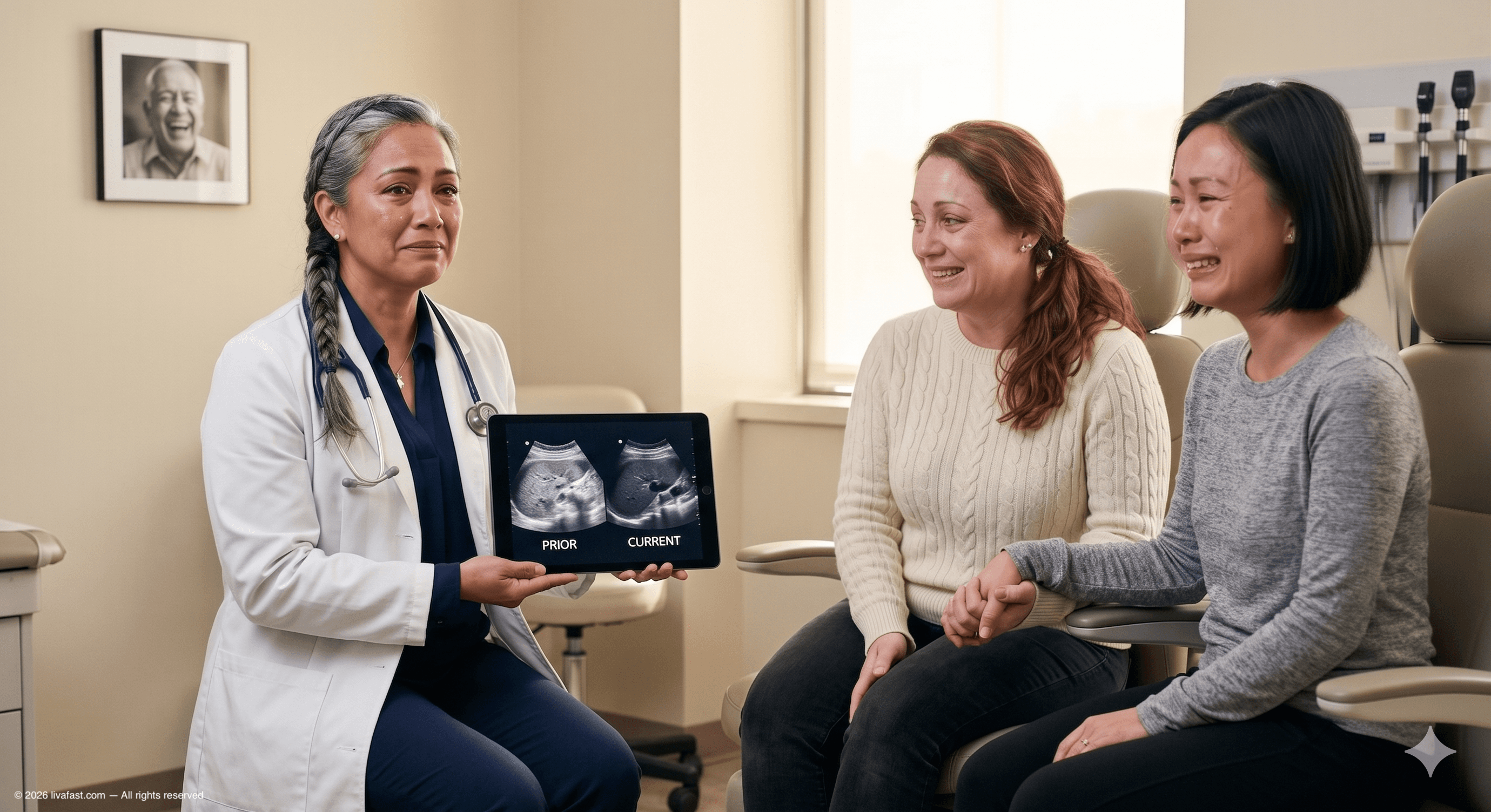
The exam-room door opened. Dr. Reyes was there. She had a tablet in her hand. Her braid was over her shoulder. She was leaning forward.
"Eleanor. Come in."
Ellie went in. Linh stood up to follow. Ellie, halfway in, paused. She turned.
"Linh. Come in. I want you to hear it."
Linh came in. They sat, side by side, in the two patient chairs. Dr. Reyes sat on her stool. She set the tablet on her knee. She turned it to face them.
The screen had two images on it, side by side. One — Ellie understood, instantly — was the November scan. The other was today's. The labels read PRIOR and CURRENT. Both were grayscale. Both showed a section of the right upper quadrant, with the kidney as a dark, kidney-shaped landmark, and the liver above it.
The November liver was bright. It glowed, almost evenly. The contrast, between the liver and the kidney, was — even to Ellie's untrained eye — sharp.
The May liver was darker. Not black. Darker. It looked, against the kidney, less bright. It looked, by the simple, eye-test reckoning of a person who had now seen enough ultrasounds to know what they could and could not show, less full of fat.
Dr. Reyes did not, immediately, speak. She let Ellie look.
"Doctor," Ellie said, finally.
"Yes."
"Is that —"
"Eleanor. The radiologist's report uses the word mild. In November, your steatosis was graded moderate-to-severe. Today, it is graded mild. The liver itself is, clinically, somewhat smaller than it was — the hepatomegaly has resolved. Your liver enzymes today — I have your blood from this morning, Jocelyn ran it stat — are within normal limits. ALT thirty-eight. AST twenty-nine. The bottom of the normal range. Your fasting glucose is ninety-two. Your A1c is five-point-four."
Linh, in the chair beside her, was making a small, quiet sound that Ellie realized, after a moment, was the sound of a person trying not to cry.
"Eleanor, your FIB-4 score, with these new numbers, is point-eight-one. Below one. That tells me — and I will repeat this, because you should hear it more than once — that we are seeing no signs of significant fibrosis in your liver. Your liver tissue is, structurally, healing. The fat is going back where it belongs, which is not in the liver. And the inflammation is going down. Massively down."
"Massively."
"Eleanor. I do not, as a rule, get to say what I am about to say. I am going to say it anyway, because I think you need to hear it, and because Linh is here and Linh will hold you to it. You reversed it. You did not finish reversing it. There is more to do. We will keep watching. But what I told you in November — that this disease was reversible — that was a hope, and a hope based on data, and a hope based on patients I had seen do it. Today, in your specific case, it is not, anymore, a hope. It is a fact. You are reversing it. You have reversed the worst of it."
Ellie did not, at first, understand what was happening to her face. There was a heat in it. There was a wetness, on her cheeks, that she had not yet noticed. She lifted her hand, and her hand came back wet, and she looked at her hand, and she understood that she had, without knowing it, started to cry.
Dr. Reyes had also, she noticed — looking up — started to cry.
Dr. Reyes, in seven years, had not, in front of Ellie, cried. Dr. Reyes, in front of any patient, in twenty-one years of practice, had cried twice — once at the bedside of a man who had reached the end of a transplant list, and once at the small, plain wedding of a former patient who had walked, three years out from her own MASLD diagnosis, down a city-hall aisle.
Today, Dr. Reyes — looking at the woman on the chair across from her, the woman who had walked into her office in November pale and afraid and almost two hundred pounds — cried for the third time in twenty-one years.
"Doctor," Ellie said.
"Eleanor."
"Are you okay."
"I'm fine."
"You're crying."
"I am, yes."
"Why."
"Because, Eleanor —" Dr. Reyes laughed, and the laugh broke a little. "Because my father had cirrhosis when I was in medical school, and he died of it before I was a doctor. And because I went into hepatology so that other people's daughters would not lose their fathers. And because I have spent my whole career telling people — people exactly like you, Eleanor, people in their forties with little girls at home — this is reversible, you can reverse this, please please please reverse this. And because most of them don't. Most of them try, and some of them do, but most of them try and they don't, and I do not, mostly, get to sit in this office and look at scans like this. I'm sorry. I'll stop in a minute."
"Doctor. Please don't stop."
Linh, now openly weeping in her chair, reached over and took Ellie's hand.
The three of them sat, briefly, in the small exam room — the patient, the physician, the friend — and they cried, quietly, together. The radiator, somewhere in the wall behind them, clanked. Outside, in May, the maples — the maples that Ellie had walked under all winter, on her way to and from a bench at the corner of Linden and Beech — were a green so new it looked, to Ellie, almost transparent in the afternoon sun.
When she walked out, twenty minutes later, with a printed copy of the imaging report in her hand and an appointment for six months from now in her phone, Ellie did not, for the first time in her adult life, feel afraid.
Linh, in the parking lot, hugged her. Hugged her for a long time. Linh was crying still, in a small, tidy, slightly embarrassed way, and Linh said, into her shoulder, "I told you, Marin. I told you."
"You told me what?"
"That the slow turtle gets there."
"You did tell me that."
"Yes I did."
"I'm a slow turtle."
"Yes you are."
"Pham."
"Yeah."
"Take me to Beatriz's. I have to tell her. And then take me to Sophie's school. I have to pick her up. And then take me — take me home. I want to go home."
"Marin."
"Yeah."
"I'd take you to the moon."
Track this in LivaFast
Your FIB-4 score updates automatically from your labs.