Chapter 25 · The Storm
Her mother is rushed to the hospital. Ellie does not break.
The call came on a Sunday in late June.
It came at eleven-thirty in the morning. Ellie was, when it came, in Beatriz's kitchen, kneading a small, shaggy dough — she had begun, that month, to bake her own bread, slowly, with whole-wheat flour, on a recipe Beatriz had gotten thirty years ago from a Polish neighbor — and the phone was on the counter beside her, and the phone, on the counter, rang.
Marcus.
She picked up with floury hands.
"Marcus."
"El. El. Mom. Mom is — Mom is in the ER. She — she went into a hypoglycemic episode. Bad. She didn't take her insulin right last night, she ate something with — I don't know, El, I don't know, the neighbor found her on the floor, she's — she's at Lakeshore. She's awake. She's awake but she's — she's shaky. I'm driving. I'm driving now. Can you —"
"Marcus. Slow down. Drive carefully. I'm coming. I'm getting Sophie. I'll meet you there."
She hung up. She washed her hands. She told Beatriz, in two sentences. Beatriz did not waste a word — Go, mi'ja. I will save the dough. Go. — and Ellie went, and she was in her car within five minutes, and she was at Sophie's friend Maya's house, where Sophie had been at a Sunday morning playdate, in eleven minutes, and she was on the highway, with Sophie buckled and silent in the back seat, in fourteen.
In the car, on the highway, Sophie said quietly: "Mom."
"Yes, peanut."
"Is Grandma going to be okay."
"I don't know, peanut. I think so. Marcus is going to be there. He's getting there before us. We'll know more soon."
"Mom."
"Yeah."
"You haven't eaten lunch."
Ellie laughed, despite herself. This child. "Peanut. I'll eat lunch when we get there. I had a big breakfast. I'm okay."
"I have a granola bar in my backpack. From the playdate. Maya's mom packed me one."
"You hold onto it, peanut. We may need it."
The highway, on a Sunday in June, was crowded. The sun was high. Ellie drove with both hands on the wheel and her shoulders, she noticed, as relaxed as she could keep them — the body, in stress, leans forward, mi'ja, you must remember to lean back — and she breathed, slowly, in the rhythm Linh had taught her in yoga class. Four in. Six out. Four in. Six out.
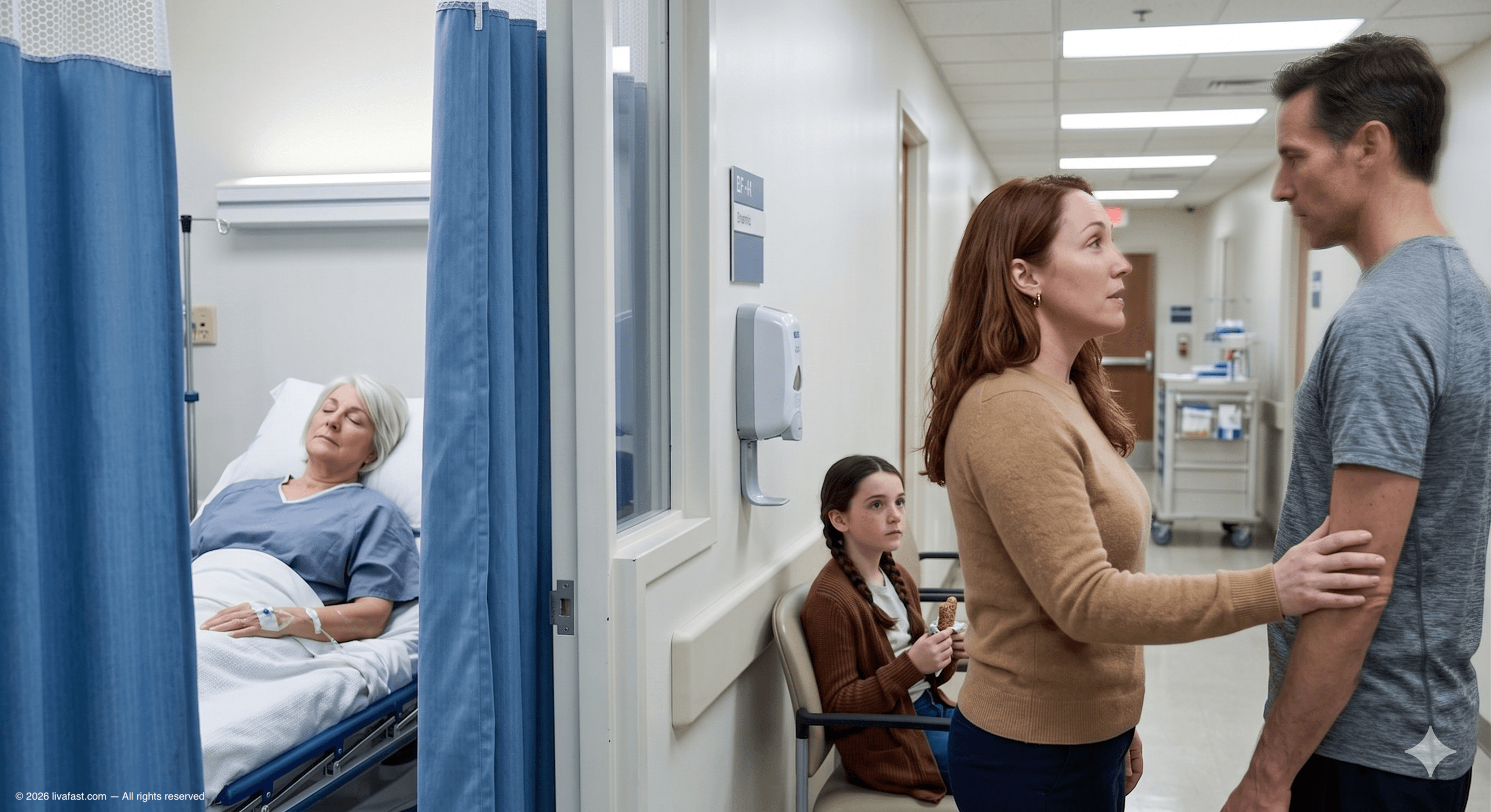
The Lakeshore ER, on a Sunday at noon, was bright and crowded and smelled, faintly, like all ERs everywhere — antiseptic and old coffee and human anxiety. Marcus was already there. He met them at the doors. He was — Ellie saw, in his eyes — the version of himself she had not seen in a long time. The frightened version. The brother who had, at sixteen, sat in this same hospital lobby on the morning their father had died.
"Marcus."
"El."
"How is she."
"She's — they have her stable. Her sugar bottomed out. They've got her on glucose. She's awake. She's — she's small, El."
"I know."
"She's — she's so small."
"I know, Marcus."
She went in. Sophie, with her granola bar in her pocket, walked behind her, very seriously, holding Marcus's hand.
Mama Rose was on a gurney in a curtained bay. She was, indeed, small — smaller than Ellie remembered, smaller than the woman who had stood over a pot of meatballs the morning her husband had died, smaller than the woman whose voice on the phone, in November, had refused to hear the word liver. She was sixty-eight. Her hair, in the fluorescent light, was pure silver. She was wearing a blue hospital gown. There was an IV in her left hand. Her right hand, on the white sheet, looked, Ellie thought, transparent.
She turned her head. She saw them.
"Eleanor."
"Hi, Mom."
"You came."
"Of course I came, Mom."
"Sophie."
"Hi, Grandma."
"Come here, baby."
Sophie went. She climbed onto a chair beside the gurney. Mama Rose, with her IV-handed left hand, very slowly reached out and laid her hand on Sophie's hair. She held it there. She closed her eyes.
Ellie watched her mother. Her mother, who, eight months before, had been a wall of denial in her ear on a parking-lot phone call. Her mother, who, three months before, had cried — cried — when Marcus had told her about his pre-diabetes. Her mother, who had — Ellie noticed, with a small, sharp pang — aged, this winter, in a way Ellie had not been there to watch.
The doctor came in. A tired-looking man named Dr. Park. He spoke to Marcus and Ellie in the hall. Mom's blood sugar had bottomed at forty-two. She had not, that morning, eaten breakfast before her insulin. She had taken her insulin and forgotten, in a way that was beginning to happen more often, to eat the toast that ought to have come after. The neighbor — God bless the neighbor — had found her, called the ambulance. She was stable. She was alert. She would be admitted overnight for observation. She needed, in the next year, more support. Either family or formal.
Marcus, beside her in the hall, looked at Ellie.
"El."
"Yeah."
"What do we do."
She thought about it. The old Ellie — the November Ellie, the pre-diagnosis Ellie, the Ellie who did not, in any meaningful way, know what to do — would have said I don't know in a small, panicked voice, and they would have, between them, decided nothing.
The May Ellie, the Ellie who had walked the conservation loop in proper shoes, the Ellie who had, that morning, kneaded a bread dough in Beatriz's kitchen with the patience of a woman who had learned, at last, no prisas, the Ellie who had — that morning — already eaten a real breakfast and was not, today, going to faint in a hospital corridor — that Ellie said:
"Marcus. We do this. We talk to Mom about an at-home aide. Today. We do not let her go home tomorrow without one set up. I will pay half. You will pay half. We will figure out how. And when she gets home, you and I will alternate dinners. You will see her three nights a week. I will see her two. She will not, in this next year, be alone for dinner more than two nights a week. We will get her food in the house that is right for her. We will throw out the food that is not. We will have done for her what we did for ourselves. And — Marcus — we are going to be kind. We are not going to scold her. We are not going to be parents. We are going to be, simply, with her."
Marcus stared at her.
"El. Who are you."
"I'm your sister, Marcus."
"You — you just — you just organized —"
"Marcus, I am hungry. Let's go in and talk to Mom. And then I'm going to sit with her. And you are going to take Sophie down to the cafeteria, and you are going to buy her a — a turkey sandwich, please — and you are going to eat one yourself, and then you are coming back, and we are going to do this. Together. Today."
He swallowed.
"Okay."
"Marcus."
"Yeah."
"I love you."
"I love you too, El."
She went back into the curtained bay. She sat down on the chair Sophie had been on. She took her mother's transparent right hand. She held it.
"Mom."
"Eleanor."
"You scared us."
"I scared myself."
"We're going to take care of you, Mom. Marcus and me. We're — we're going to put some help in, and we are going to come for dinner. And — and you, Mom — you are going to let us. Yes?"
Mama Rose closed her eyes. A single tear came out at the corner of one. It ran down into her silver hair.
"Eleanor."
"Yes, Mom."
"I'm sorry."
"For what, Mom."
"For — when you called me. From the parking lot. When you told me about the liver. I — I was — I was so afraid. I have been so afraid for so long. I — I should have come. I should have said the right thing. I —"
"Mom. Stop. We are not — we are not doing the past today. We are doing today, today. I love you, Mom. I am here. Marcus is here. That is what is happening today."
Mama Rose, with her transparent hand, squeezed Ellie's.
That night, after they had gotten Mama Rose admitted and settled in a real room, after the at-home aide had been arranged for the next day, after Marcus had taken Sophie home with him so Ellie could stay with their mother, Ellie sat in the chair by her mother's bed, and she watched her mother sleep, and she did, on the small Tupperware Beatriz had pressed into her hands at the door — eat, mi'ja, eat at the hospital, you must eat — make herself eat: a piece of chicken, a small pile of black beans, a wedge of orange, a square of dark chocolate.
She did not, that night, fast.
She had decided, in the parking lot, walking from the car to the entrance, that she would not. The body in crisis, the coach had said to her once — quietly, in March — needs fuel. She had decided that the new life she had built was not so brittle that it would break if she ate dinner at nine on the night her mother had almost died. She had decided that her health was, now, a thing that could bend.
The next morning, in the chair by her mother's bed, in the gray pre-dawn, she opened the app, and she logged the previous night honestly:
Day 244. Mom hospitalized. Did not fast. Ate dinner at 9pm. Important to note: did not feel guilt. Did feel love.
The coach replied: That is the strongest thing I have read from you yet.
Track this in LivaFast
Your FIB-4 score updates automatically from your labs.