Chapter 27 · The All-Clear
Fourteen months. We can find no fatty infiltration. A new commission.
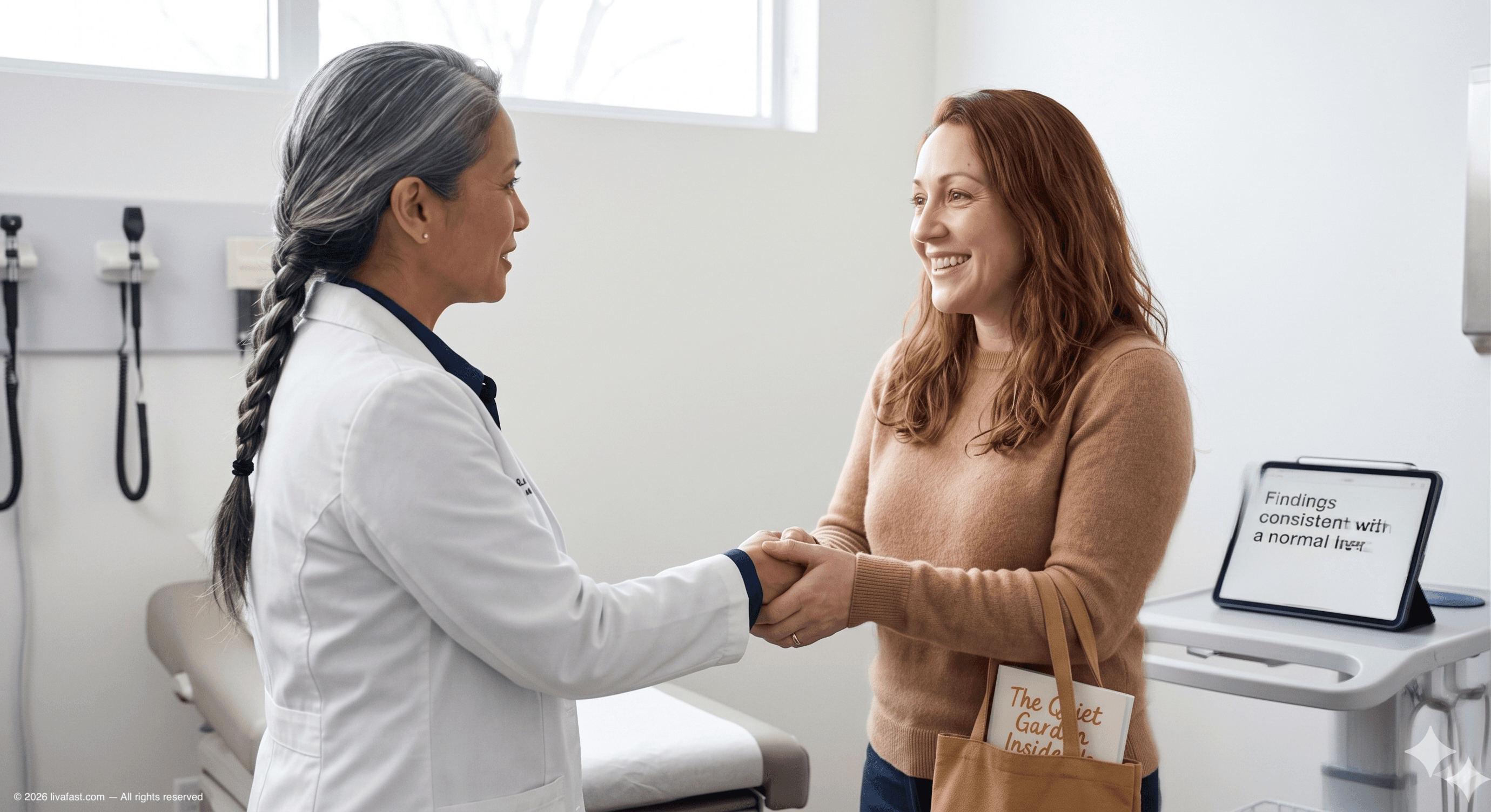
Dr. Reyes had, by January, fourteen months in, begun to scold her — kindly, in the way one scolds a friend — for dressing up for appointments.
"Eleanor."
"Doctor."
"Why are you wearing earrings."
"They're very small earrings."
"I have not seen you in earrings."
"I have a meeting after this."
"Mm-hm."
The fourteen-month scan had been scheduled for the third Wednesday of January. Ellie had, in the run-up, not allowed herself to assume anything. The June scan — the eight-month one — had shown the steatosis as mild, which was a confirmation rather than a transformation. The fall labs had been within normal limits but had not, on their own, told her anything new. I am not going to predict, she had told Linh on the phone the night before. I am going to walk in. Whatever it says, it says.
Dr. Reyes had read the report on her tablet for a long, slow minute.
She set the tablet down. She did not, today, lean forward. She leaned, instead, back. She folded her hands in her lap. She looked at Ellie across the small exam room.
"Eleanor."
"Yes."
"I want to read you a sentence."
"Okay."
She picked up the tablet again. She found, with her thumb, a line in the radiologist's report. She read it aloud, slowly, the way a teacher reads a paragraph aloud to a class she wants to remember it.
"The hepatic parenchyma is homogeneous in echotexture, with no convincing evidence of fatty infiltration. The liver is normal in size. There is no focal lesion. The findings are consistent with a normal liver."
Ellie, in the chair, did not, at first, move.
"Eleanor."
"Yes."
"Did you hear me."
"I heard you."
"This says no fatty infiltration."
"Yes."
"This says, consistent with a normal liver."
"Yes."
"Eleanor."
"Yes."
"I am going to use a phrase I do not use lightly. Your imaging is, today, what we call all clear. Your blood work is, today, normal. Your fibrosis markers are, today, normal. Your A1c is, today, prediabetes-resolved. You have reversed your MASLD. Eleanor — I am going to be clinically careful, and I am going to say: as far as we can detect, today, with the tools we have, in the body in front of me, you have reversed your MASLD. This is not — and please listen to me — this is not a permission slip to go back to who you were a year ago. The disease lives in the behaviors, Eleanor. The behaviors made it. Different behaviors unmade it. The behaviors must continue, or it will come back. But within the boundary of what you have done, and what you are doing, and what you intend to keep doing —"
"Yes."
"— Eleanor. You did it. You reversed it."
There was a moment in the exam room. The kind of moment that, in fiction, gets written as a kind of stillness. In reality, it is not still. The radiator clanked. Outside, a car horn honked. Dr. Reyes's pager — small, black, clipped to her white coat — buzzed once and was silent. Jocelyn, in the hall, walked past humming an old song.
Ellie, in the chair, did not, this time, cry.
She had, she realized, rehearsed this moment a hundred times in her head, and had not, in any of the rehearsals, gotten it right. In her head, this moment had always been a great, sweeping, weeping moment. In the chair, in the actual exam room, on the actual third Wednesday of January, the moment was instead — quiet. Smaller than she had imagined. Inevitable, in a way. Ordinary, in the way that big news, when it comes, is often ordinary. It was the news that the body — patient, faithful, quietly working — had, when given the chance, done the only thing the body, in any age, given the chance, will do.
It had healed.
"Doctor."
"Yes, Eleanor."
"Thank you."
"Eleanor. I did not heal you. You healed you."
"Doctor. I — you sat across from me in November, and you told me it was reversible. There was — there was no other doctor in this city, in November, who would have looked me in the eye and used that word with the certainty you used. I am — I am not very good at thanking people. I want to thank you. I want to thank you because — because I would not have known, in November, what to ask of myself, if you had not, that day, asked it of me first. I would not have asked of myself what you asked of me. So — thank you."
Dr. Reyes did not, for a long moment, speak.
Then she said — and her voice was thicker than usual, but not, today, breaking — "You are welcome, Eleanor."
She stood up. She extended her hand. It was the first time, in fourteen months, that they had shaken hands. They did. Dr. Reyes held on a beat longer than a doctor would. Then she let go.
"Six months, Eleanor. We watch. Forever."
"Forever."
"Forever."
She walked out of the office. She rode the elevator down. She stepped out into a cold January afternoon. The light was the low, white, midwinter light. The maples, on the lot, were bare. Her breath, in the cold, was visible. She walked to her car. She did not, immediately, get in.
She stood, for a long minute, in the lot. She put her hand against her right side, beneath her rib. She held it there.
The ache that had been there, in November of the year before, was not. It had not, in fact, been there for months. She had, today, with the stethoscope of her own palm, checked, the way one checks a kettle for whether it has, at last, gone off the boil.
The kettle was off the boil.
She got in the car.
She drove not home, but to a small bookstore on Chestnut Street — the one where, in November, her daughter had found the book about bowhead whales. She walked in. She bought, with her own small allowance for joy, three things: a notebook (a green one, this time, because the blue one was full), a fountain pen (which she had wanted, for years, and had told herself was an extravagance), and a small, beautifully-printed children's book about — of all things — a turtle.
She drove to Sophie's school. She picked her up. She drove home.
That night, after dinner — a salad of arugula and roasted beets and walnuts, two pieces of poached chicken, a slice of bread Beatriz had baked that morning, and a small wedge of dark chocolate as a dessert — she told Sophie. She told her in the kitchen, at the small wooden table, with her hand on her daughter's small, freckled hand. She used Dr. Reyes's exact words.
"No convincing evidence of fatty infiltration. The findings are consistent with a normal liver, peanut. That's what the doctor said. Today."
Sophie looked at her.
Sophie's face, very slowly, broke into a smile so wide it changed the whole geometry of her face.
"Mom."
"Yeah."
"You did it."
"I did."
"Like the bowhead whale."
"Like the bowhead whale, peanut."
She did not, that night, write a long entry in the app. She wrote only:
Day 446. Cleared. The body did its work. Going to sleep now.
The coach replied: Sleep well, Eleanor.
In her bag, on the chair, lay an envelope she had not yet opened — the one her publisher had given her that afternoon, while she had been sitting in Dr. Reyes's exam room across town. A new commission. A book for children, eight-and-up, from a young writer she had never worked with before, that her editor had thought of her for. The title, hand-lettered on the cover of the manuscript, was The Quiet Garden Inside Us. It was about, the cover note said, the small, faithful organs that keep us alive — the heart, the lungs, the liver, the gut — and what they do, in the quiet, while we go about our days.
She had, she realized, been waiting her whole life to draw this book.
She opened the envelope. She read the first page in the lamp-light. She would, for the next year, draw, with the new fountain pen, a glowing organ behind a child's hand. She would draw the heart in red. She would draw the liver in a soft, shy ochre. She would draw, with great care, on the last page of the book, a small, glowing, golden ring — like a fasting timer — circling, gently, an open palm.
She did not think anyone, looking at the last page, would understand.
She did not think it mattered.
Track this in LivaFast
Your FIB-4 score updates automatically from your labs.