Chapter 29 · Sophie's Speech
My mother is the bravest person I know.
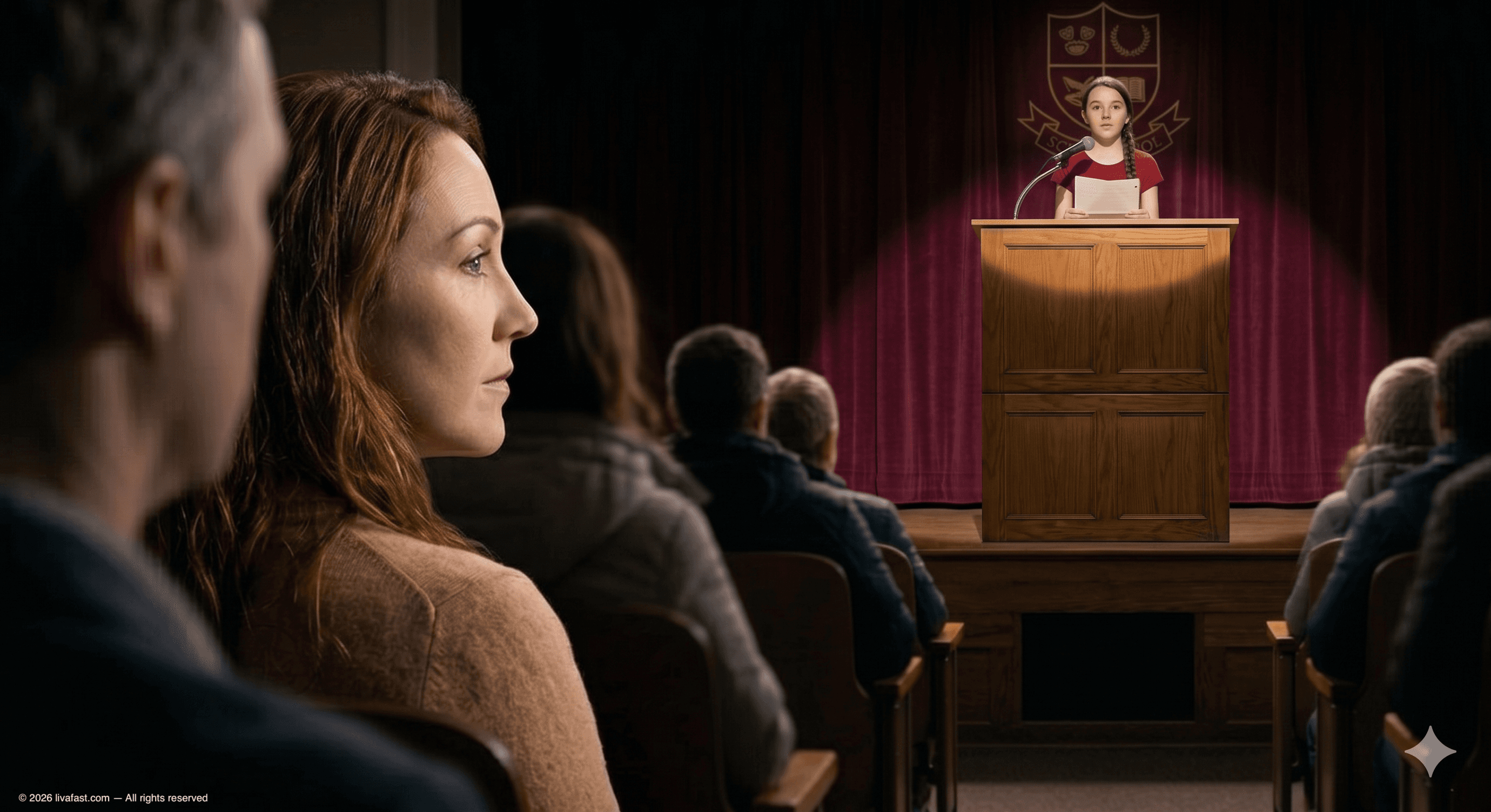
The school assembly was on a Friday morning in May. Sophie had, that spring, won the fifth-grade essay contest. The prompt had been My Hero. The essay had not been, as Ellie had at first quietly suspected, about a fictional whale, or about Mrs. Quintero, the music teacher. It had been about her mother. Sophie had read the essay aloud at home, on a Sunday in March, before she submitted it, sitting on the rug in front of Ellie's chair with her notebook in her lap, and Ellie had — at the end — gone into the kitchen for an entire glass of water that she had not really wanted, because she had not wanted to cry in front of her child.
Now, in the school auditorium — the same auditorium with the brown carpet and the low stage and the piano with the yellowing key — Ellie was sitting in the first row.
She was sitting in the first row because she could, today, climb to any row in any auditorium, and because Sophie had asked her to sit in the first row, and because Linh — who had come, with Beatriz, and Marcus, and Mama Rose, and Theo — had insisted that Ellie not, today, hide in the back.
Mama Rose, on her left, was sitting up straighter than Ellie had ever, in her adult life, seen her sit. She had, for the assembly, worn the pearl earrings Ellie's father had given her in 1986. Beatriz, on her right, was wearing her flowered apron, because, she had said in the lobby, I cleaned the kitchen and forgot to take the apron off, mi'ja, I am sorry, I am here, the apron is here, that is what is happening today. Marcus and Tessa sat behind them. Linh and Theo flanked the row.
Mrs. Quintero, at the lectern, called Sophie's name.
Sophie walked across the stage. She was eleven years old now. She was tall for eleven. She had, in the past year, grown three inches. She was wearing the red dress from the recital, and the same sneakers (which still fit), and her hair was in a single thick braid down her back. She set her speech on the lectern. She looked out into the auditorium. She found her mother.
She smiled.
"My hero," Sophie said into the microphone, "is my mom.
"My mom is a children's-book illustrator. She draws foxes and rabbits. She has been doing this since before I was born. She is a very good illustrator. But that is not why she is my hero.
"A year and a half ago, my mom got sick. She had a thing called fatty liver disease. The doctors told her she could fix it, but only if she was willing to change a lot of things about her life. She had to walk every day. She had to stop eating sugar. She had to fast for sixteen hours every night. She had to sleep more. She had to go to yoga. She had to learn to cook with our neighbor Beatriz. She had to do all of this for over a year, every single day, even on the days when she did not feel like it.
"My mom did all of it.
"She did all of it even though, at the beginning, she was scared. She did all of it even though, in the middle, the scale stopped moving and she wanted to give up. She did all of it even though, sometimes, her head hurt because her body missed the sugar. She did all of it even though her own mom — my grandma — got sick, in June, and my mom had to take care of her, too, while still taking care of herself.
"My mom is healthy now. The doctors say her liver is normal. They say she reversed her sickness. They say not many people do this. My mom did it.
"But that is not, exactly, why she is my hero either.
"My mom is my hero because, when she got sick, she did not pretend she was fine. She was scared, and she said so. She was sad, and she said so. She cried in front of me. She apologized when she snapped at me. She made me promise never to pretend, with my body, the way she had pretended for a long time. She told me that adults are sometimes scared, and that being scared is not the opposite of being brave. She told me that being brave is what you do while you are scared.
"My mom is my hero because she did not just save her own life. She helped my Uncle Marcus. She helped my Grandma. She helped our neighbor Beatriz feel less alone. She is, this year, drawing a book about a quiet garden that lives inside us. She talks to me about it, at the table, while she is drawing.
"My mom is the bravest person I know. She is the bravest person I have ever met. I love her very much. I am so glad she is my mom. The end."
Sophie folded the page. Sophie picked up the page. Sophie walked off the stage.
There was a long, loud silence. Then there was applause. The applause went on, and on, and on, in the way that applause goes on when an audience has, mostly, forgotten itself.
Ellie, in the first row, did not move. She did not, at first, breathe. She put both hands over her face. Mama Rose, beside her, was crying — the loud, undisguised crying of a sixty-eight-year-old woman who has been holding a great many things — and on Ellie's other side, Beatriz was, with great dignity, fishing a tissue out of the pocket of her flowered apron and pressing it into Ellie's hand. Behind her, Marcus was making a small, guttural, brotherly sound that was the sound of a man not crying yet. Tessa, beside him, was crying for both of them. Linh, two seats over, was — in the way of yoga teachers — breathing, slowly, audibly, with her hand flat on her own chest. Theo, on the aisle, was sitting very still, and was looking at her with an expression Ellie did not, for a long second, recognize.
Sophie, at the back of the stage, found her mother's eyes. Sophie waved. Sophie's eyes were wet, but Sophie was smiling, and the smile, this time, was even bigger than at the recital — it was the smile of a child who had, for a long time, been holding a thing inside her own chest, and who had, today, been allowed to set it down on a stage.
Ellie waved back.
The principal said something that Ellie did not, after, remember. The next student walked up. The assembly continued.
In the lobby, after, with the family in a small crowd around her, Sophie came running. Ellie knelt — easily, this time — and opened her arms. Sophie threw herself in. Sophie smelled, as always, of pencils.
"Peanut."
"Mom."
"Peanut. Peanut."
"Mom. I meant every word."
"I know you did."
"Mom."
"Yeah."
"You're squeezing too hard."
"I know I am."
"I love you."
"I love you too, peanut. I love you too."
That night, in the apartment, with the family scattered on the couch and the chairs and the rug — Beatriz with the white dog Pepe asleep on her lap, Mama Rose in the armchair with a cup of tea, Marcus and Tessa on the rug with Sophie playing a game on her phone, Linh on the couch with her shoes off, Theo in the kitchen washing the bowls from the dinner he had, that night, made — Ellie stood in the doorway between the living room and the kitchen, and she watched her own life, in her own apartment, full of people who, eighteen months ago, had not all known each other.
She did not, in that moment, write anything in the app. She did not, in fact, even think of the app.
She thought only — distinctly, without fanfare — I am alive.
Track this in LivaFast
Your FIB-4 score updates automatically from your labs.