Chapter 7 · The Ultrasound
A black-and-white image of an organ she has never thanked.
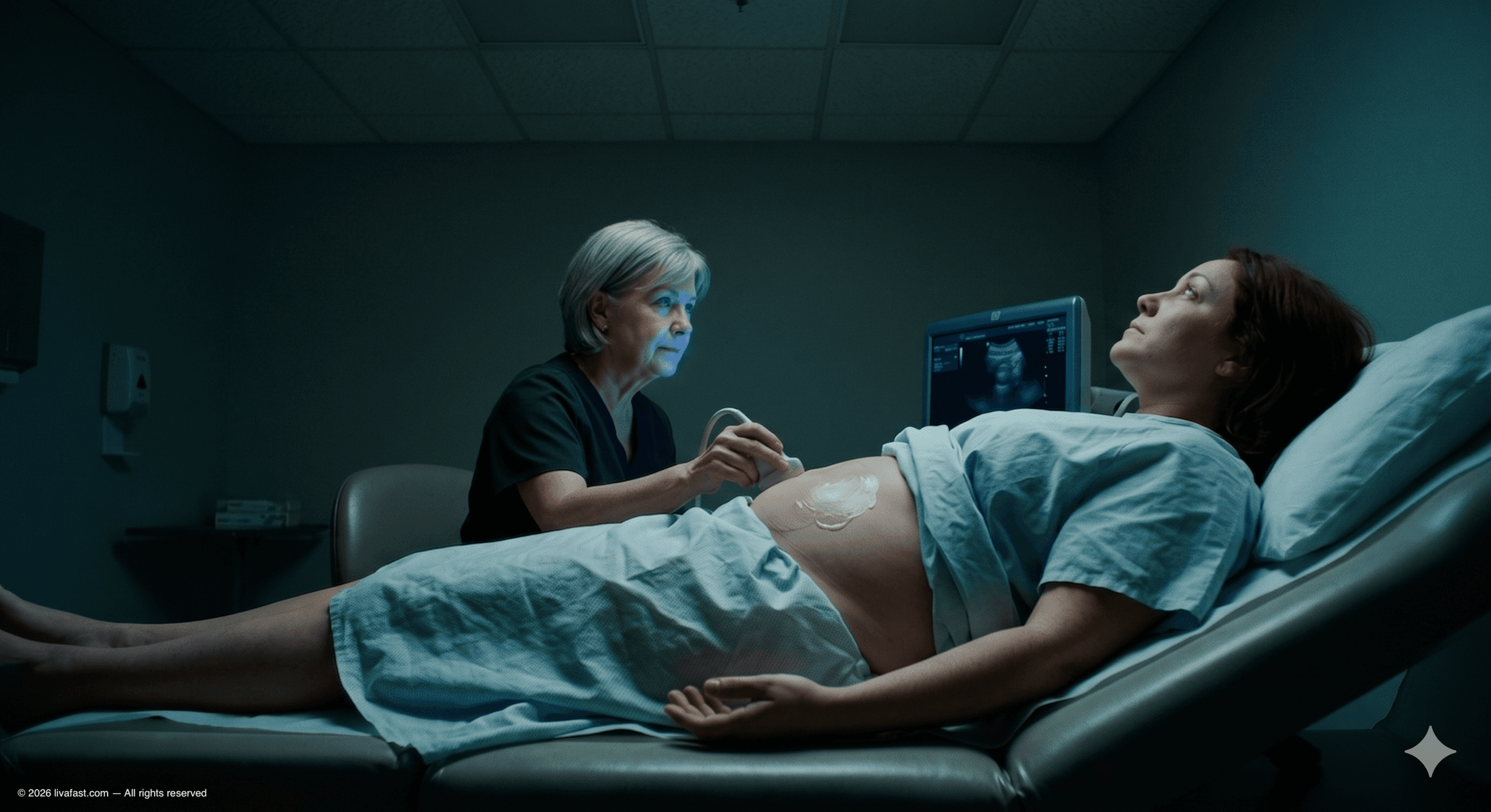
Riverside Imaging was in a low brick building beside a small, anxious-looking river that had been straightened by an Army Corps engineer in 1962 and had, ever since, looked vaguely surprised to find itself there. Friday morning was overcast and cold. Sophie sat in the waiting room with a coloring book about whales and a small thermos of hot chocolate. Linh sat next to her.
"You don't have to stay," Ellie said, for the third time, to Linh.
"Marin," Linh said, "if you tell me to leave one more time, I'm going to tell Sophie about that thing you did at karaoke in 2012."
"Mom did what?" Sophie said, looking up from the whale.
"Nothing," Ellie said. "She's bluffing."
"She's not bluffing," Linh said.
The technician, a woman with short gray hair and a soft Boston accent, called her in. Ellie kissed Sophie on the top of the head. Linh squeezed her hand. The exam room was small and dim and smelled, faintly, of latex and the kind of soap they used in hospitals. Ellie lay down on the table. The technician — her name was Margaret — adjusted her gown, told her she would be cold, and squirted a long, blue line of gel onto her abdomen.
The gel was cold. Margaret began.
The probe slid over Ellie's stomach in slow, deliberate arcs. Margaret was looking at a screen Ellie could not see. The room was almost silent — only the low hum of the machine, the wet sound of the probe, the small click of Margaret tapping a button at intervals.
"We measure," Margaret said quietly, in the voice technicians use to fill the silence without filling it. "We measure the size of your liver. We look at the texture. We look for any structural anomalies. The doctor will read it. I just take the pictures."
"Mm-hm," Ellie said.
The probe paused. Margaret pressed slightly harder, just under the right rib. The ache lit up. Ellie did not flinch.
"Tender there?" Margaret asked.
"A little."
"Mm." Margaret took two more pictures.
There is a thing that happens in an ultrasound room. The patient is on her back, in a paper gown, with cold gel on her body, and she is looking at the ceiling, which is acoustic tiles, and she is trying very hard not to read the technician's face. The technician is trained — trained — not to give anything away, and the patient is trained — by every doctor's office she has ever sat in — to read everything anyway. Ellie watched Margaret's face out of the corner of her eye. Margaret's face was a kind, professional blank.
"Almost done," Margaret said, after what felt to Ellie like an hour and was, in fact, eighteen minutes.
She wiped the gel off Ellie's stomach with a warm, rough towel. She helped Ellie sit up. She handed her a fresh paper towel for any gel she had missed.
"The radiologist is on site," Margaret said. "Your doctor — Dr. Reyes — has asked us to send results immediately. She wants to see you today."
"Today?"
"Yes. They've made an appointment for you for noon."
"Why today?"
Margaret hesitated. It was the smallest hesitation, but it was a hesitation, and Ellie understood at once.
"You'll need to ask Dr. Reyes," Margaret said gently. "I just take the pictures, sweetheart."
In the waiting room, Sophie had moved to a green whale and was carefully, carefully, coloring its belly white. Linh stood up when Ellie came out.
"Today at noon," Ellie said.
Linh did not ask why. She had, like Ellie, understood. "I'll take her to lunch," she said. "We'll meet you wherever you want, after."
"Will you take her to the bookstore? She'll lose her mind if you take her to the bookstore."
"I'll take her to the bookstore."
"Mom," Sophie said, looking up. "Are we going to the bookstore?"
"Linh's taking you."
"After your other doctor?"
"Yes."
"Okay." Sophie capped the green crayon, opened a yellow one. "I want to find a book about the kind of whale that lives the longest."
"Bowhead," Linh said. "Bowhead whales. Up to two hundred years."
"Two hundred?"
"Two hundred."
"That's so long."
"It is, kid."
Ellie watched her daughter's small head bend back to the coloring book. Two hundred years. Some animals lived two hundred years. Some animals — she did not finish the thought. She kissed Sophie on the head again. She went out into the parking lot, and she sat in her car, and she drove the eight blocks to Dr. Aiyana Reyes's office with both hands on the wheel and her eyes very steady on the road.
Track this in LivaFast
Your FIB-4 score updates automatically from your labs.