Chapter 8 · The Word "Cirrhosis"
The diagnosis. A drive-through she does not pull into.
Dr. Aiyana Reyes was forty-seven years old and had a dark, slightly graying braid that fell over her shoulder when she leaned forward, and she leaned forward when she was telling you the truth.
"Eleanor," she said. "Sit down."
The exam room was warmer than Dr. Patel's. There were two chairs and a small examining table and, on the wall, a framed black-and-white photograph of a man Ellie thought, instinctively, must be Dr. Reyes's father. The man was laughing at something just outside the frame. The photograph had been there a long time. The frame was a little tarnished at one corner.
"I've reviewed your imaging," Dr. Reyes said. "I want to walk you through it, and I want you to ask any question, at any point, even if it feels stupid. Promise me."
"Promise."
"Your liver is enlarged. Hepatomegaly. That accounts for some of the discomfort under your right rib. The liver itself looks bright on imaging — that brightness is fat. The radiologist has graded what we call hepatic steatosis as moderate-to-severe. That is not the worst grade. There are people with more fat than you have. But it is more than I would like to see in a thirty-nine-year-old."
Ellie nodded.
"Your blood work confirms what the imaging shows. Your liver enzymes are elevated, which means there is some level of injury or inflammation in the liver tissue itself. The good news — and there is good news, Eleanor, I want you to hear me say it — the good news is that your imaging shows no signs of advanced fibrosis. We will run a calculation called a FIB-4 score, which is going to use your blood work, your age, your platelets, and a few other factors. Based on what I've seen, I expect it to fall in the low-risk range. We may also do a non-invasive elastography in a few weeks."
"What does that mean?"
"It means: as far as we can tell today, your liver has fat in it, your liver is irritated, your liver is suffering — and your liver has not yet scarred itself to the point of structural change."
"Okay."
"Eleanor, do you know the word cirrhosis?"
The room tilted, very slightly. The wall with the photograph leaned an inch to the left. Ellie made herself breathe.
"I know the word."
"I am going to use it once. Cirrhosis is the end stage of liver disease. Cirrhosis is when the liver has scarred itself so extensively that it can no longer regenerate. Cirrhosis kills people. You do not have cirrhosis. I want you to write that sentence down in your phone before you leave this office, and I want you to read it the next time you wake up at three in the morning and Google the word."
"Okay."
"What you have, today, is reversible. Do you hear me?"
"I hear you."
"I need you to actually hear me, Eleanor. Steatosis — even moderate-to-severe steatosis, in the absence of significant fibrosis — is reversible. We have seen it. I have seen it. I have patients who walked into this office with imaging that looked like yours and who, two years later, walked out with imaging that looked like a textbook normal liver. Not because we cured them with a pill. We do not, today, have a pill for this. We have not cured them with surgery. We do not, in your case, do surgery for this. We have reversed it with what we call lifestyle medicine. That is a medical phrase, Eleanor. It is not a wellness phrase. It means: nutrition, weight loss, movement, sleep, sometimes time-restricted eating, the addressing of your blood sugar, and the reduction of certain things in your diet — most importantly, sugar and refined carbohydrates."
"Sugar," Ellie said.
"Sugar. Especially fructose. Especially sweetened beverages and ultra-processed foods and what I am going to bluntly call the donut at ten-thirty in the morning."
Ellie laughed, helplessly. The laugh broke and turned into something else, and she put her hand over her mouth.
Dr. Reyes did not move. She let her have the moment. When Ellie lowered her hand, Dr. Reyes leaned forward — there it was, the brown braid sliding over her shoulder — and said, more quietly:
"Eleanor. I am not going to tell you this is easy. I am going to tell you it is doable. And I am going to walk with you. I am going to refer you to a registered dietitian. I am going to give you literature. And I am going to give you the name of an app. Several of my patients use it. It tracks fasting windows, it tracks sleep, it tracks nutrition, it pulls in your Apple Watch data if you have one, it generates a thing called a Liver Score that is — I am not going to oversell it — a useful daily picture of how your habits are aligning with what your liver needs. You don't have to use it. Some patients prefer a paper journal. But many find it helpful, especially in the first six months, when the changes are invisible."
"An app."
"An app. The name is in the printout I'm going to give you. Use it or don't. Your choice."
"Okay."
"I'm going to see you in six weeks. Until then — I want you to do three things."
"Three things."
"One. Cut sweetened beverages entirely. Soda, sweetened coffee drinks, juice, sweet tea — gone. Water, plain coffee, plain tea, sparkling water. That is your beverage list now."
"Okay."
"Two. Walk. Every day. For now I do not care how far. Around the block, around the parking lot, around the kitchen. Every day, without fail, you walk."
"Okay."
"Three. Stop eating after seven o'clock at night, and don't eat again until at least eight in the morning. We're going to start there. Twelve hours. We will build the fasting window from there. Some of my patients work up to sixteen-and-eight, which is what we call sixteen hours of fasting, eight hours of eating. We're not there yet. We start at twelve."
"Okay."
"Eleanor."
"Yes."
"You came in. That is the hardest part you will ever do. The rest of it is hard, but it is hard the way climbing a hill is hard. The coming in was hard the way deciding to climb the hill is hard. You have done it. Do you understand?"
Ellie nodded. She could not speak. Dr. Reyes reached across the small distance between them and took her hand, briefly, the way a physician sometimes does — a small, deliberate touch — and then she let go.
"I'll see you in six weeks," she said. "Sooner if you need me."
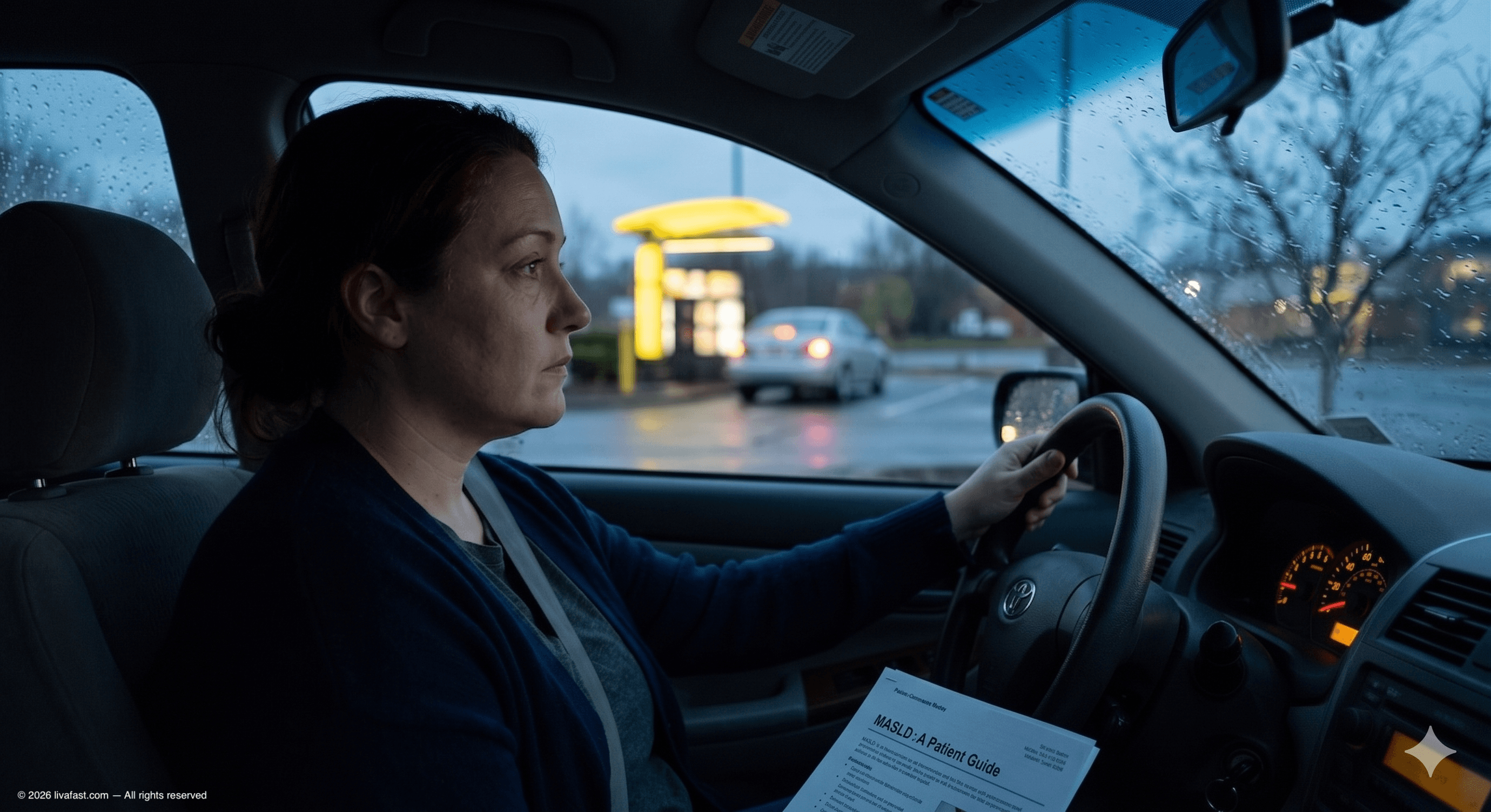
In the parking lot, Ellie sat in the driver's seat with the engine off and the printout in her lap. MASLD: A Patient Guide. A list of foods. A list of behaviors. The name of an app, in italics on the second page.
She drove. She drove past the intersection where, in another life — eight days ago — she would have turned right toward the drive-through. She did not turn right. She felt the pull, sharp and almost physical, of the thought of a milkshake. She felt her body lean toward it, the way a plant leans toward a window.
She drove past.
A block later, in the next intersection, she turned in to the bookstore parking lot. Sophie was inside, with Linh, looking for a book about the kind of whale that lives the longest. Ellie sat in her car, and she put her hand against her right side, and she said, out loud, the sentence Dr. Reyes had asked her to write down.
I do not have cirrhosis.
She said it again.
She got out of the car. The cold autumn air hit her face. She walked into the bookstore, and Sophie was kneeling in the children's section beside Linh, holding up a book with a bowhead whale on the cover, and the bowhead whale, with its serious, ancient eye, looked out from the cover at Ellie like a creature that had decided, two centuries ago, to live.
Sophie ran to her. Ellie knelt — slowly, but more easily than she had three days before, though she could not yet tell whether this was true or whether she only wanted it to be — and she hugged her daughter, and Sophie, against her shoulder, said, very quietly: "Are you okay, Mom?"
"I'm okay, peanut," Ellie said. And she meant it, in a way she had not meant it for years.
"Linh got me a hot chocolate."
"Of course she did."
"Mom."
"Yeah."
"You smell like outside."
Ellie laughed into her daughter's hair, and the laugh, this time, was the laugh of a woman who had walked into a doctor's office afraid she was dying and walked out, instead, holding a printout that began with the words You can reverse this.
Track this in LivaFast
Your FIB-4 score updates automatically from your labs.