Chapter 9 · The Donut Funeral
She empties the pantry. Her daughter watches.
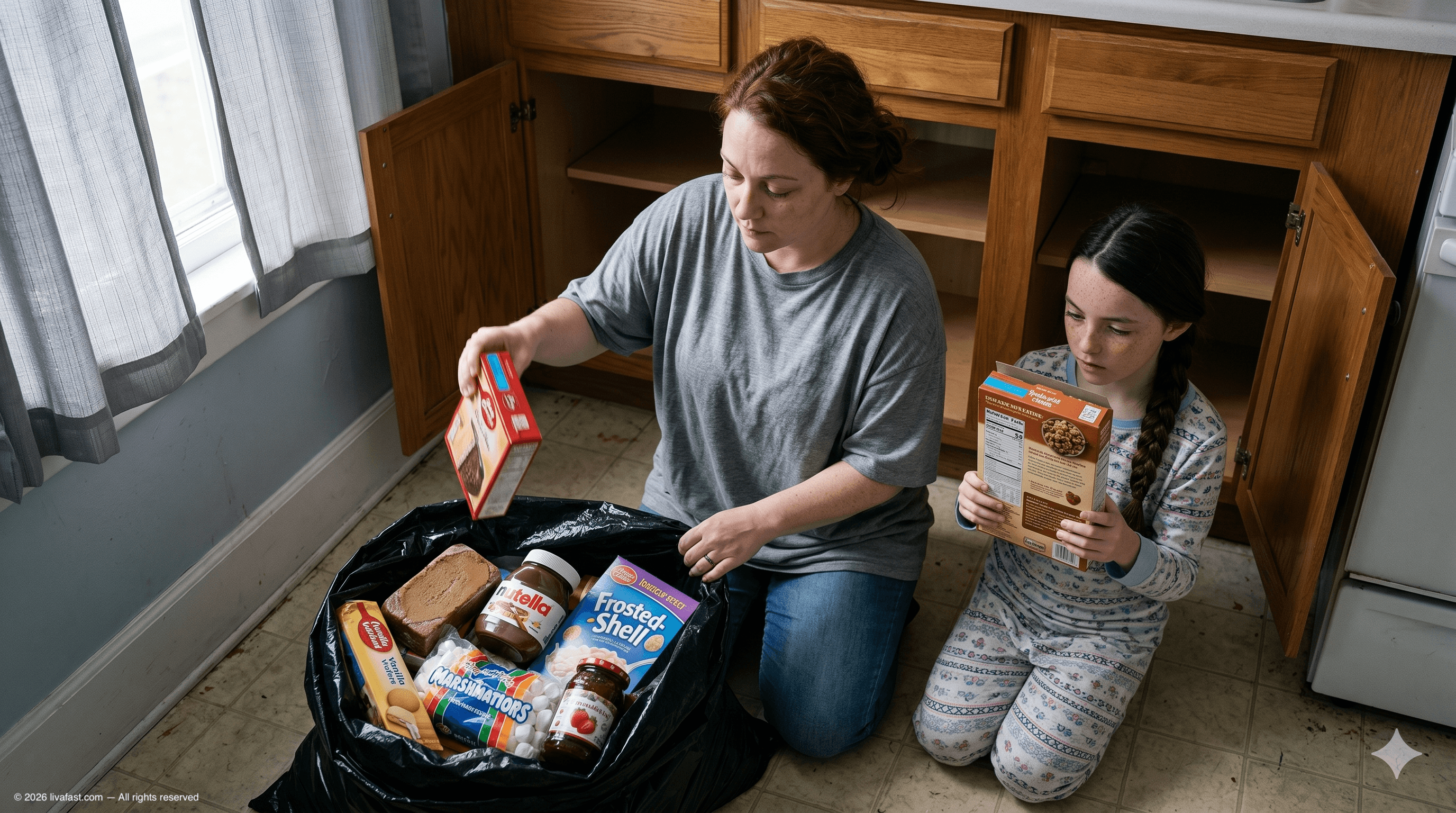
She emptied the pantry on a Saturday.
It was not, at first, planned. It began with her looking for crackers. She had decided to make herself a piece of toast, and she had opened the bread bag and found, behind it, a half-finished sleeve of vanilla wafers. She had stared at the vanilla wafers. She had thought, I should throw these out. And then, with a small, internal click that she would later think of as the moment her life turned, she had thought, I should throw all of it out.
She got a black trash bag. She set it on the floor.
Sophie wandered in, in her pajamas, halfway through her morning whale book.
"Mom?"
"I'm cleaning, peanut."
"At nine in the morning?"
"At nine in the morning."
Ellie opened the cabinet over the stove. She took down the box of brown sugar, which had hardened to a brick a year and a half ago and which she had not, in all that time, had the heart to throw away. Into the trash bag. She took down the jar of generic chocolate spread. Into the bag. She took down the two boxes of breakfast cereals — the kind shaped like little frosted shells — and the bag of marshmallows from a hot chocolate kit in February, and the half-empty jar of caramel sauce, and the jar of strawberry jam that had sugar listed first on the ingredient label, and the box of cake mix she had bought for Sophie's eighth birthday and never used. Into the bag. Into the bag. Into the bag.
Sophie was watching her, very carefully, from the kitchen table.
"Mom."
"Yes, peanut."
"You're throwing out all our food."
"Not all of it."
"You threw out the marshmallows."
Ellie turned around. She set the bag down. She sat in the chair across from her daughter, and she took both of Sophie's small, freckled hands in hers, and she said, quietly, "Peanut. I have to tell you something."
Sophie waited.
"At my doctor's appointment yesterday — the second one, with Dr. Reyes — they told me that I have something called a fatty liver."
"What does that mean?"
"It means that, for a long time, I haven't been taking very good care of my body, and my body is letting me know."
"Are you going to die?"
Ellie did not flinch. She had known this question would come. She had rehearsed it in the car. She squeezed Sophie's hands, and she said, "No, baby. I am not going to die. The doctors caught it early. They said I can fix it. But I have to make some changes. I have to walk every day. I have to eat differently. I have to sleep more. And I have to stop eating things that have a lot of sugar in them. So I'm cleaning out the kitchen."
"All of it?"
"Most of it."
"Do I have a fatty liver?"
The question, asked so quickly and so calmly, broke Ellie's heart in a small, clean place.
"No, peanut. Children almost never get this. And you are not me. But I would like — and you can say no, and I will not be hurt — I would like for us, together, to start eating in a way that is good for both of our bodies. Some sweet things, sometimes. But not so many. Not so often. We can make this fun. We can pick recipes together. Yeah?"
Sophie thought about this. She thought about it the way she thought about everything — slowly, with her whole face.
"Can we keep the maple syrup?" she said. "For pancakes. On Sundays."
"On Sundays."
"And the chocolate chip cookies Mrs. Garber makes me on my birthday."
"Mrs. Garber stays."
"And —" Sophie paused. "Mom."
"Yeah."
"I think we should keep the marshmallows for emergencies."
Ellie laughed, the first true laugh in a week. "Okay, peanut. We'll keep one bag of marshmallows for emergencies. In the back of the cupboard."
"Can I help?"
"With cleaning out?"
"Yeah."
"Yes," Ellie said. "Yes, you can help."
They worked together for an hour. Sophie, with her serious eyes, read every ingredient label. Mom, this one says high-fructose corn syrup. Mom, this one is okay, but it's expired. Mom, this one is the kind of granola that has more sugar than the cereal. They filled the trash bag and most of a second one. They wiped out the cabinets with vinegar and water. They put the things they were keeping back in — the rice, the beans, the canned tomatoes, the pasta, the olive oil, the spices, the tea — and Ellie noticed, looking at the cabinets with their honest, ordinary contents, that the kitchen looked, for the first time in years, clean.
Not cleaner than usual. Clean, in the way a thing looks when nothing in it is hiding.
They walked the trash bags out to the alley together. Sophie, in her pajamas under a coat, carried the smaller one with both hands. The morning was cold. The maple at the corner of the alley was almost bare.
"Mom," Sophie said, on the walk back.
"Yeah."
"I'm proud of you."
Ellie did not answer for a long moment. She could not. She kissed the top of her daughter's head, and they went inside, and that night, for dinner, they ate scrambled eggs with cheese and a salad of spinach and tomatoes and avocado, and Sophie ate the whole salad without complaining, and at seven o'clock, Ellie washed the dishes and turned off the kitchen light, and on her phone she opened a notes app and typed, with two fingers, the first entry of what would become a long, slow record of a life she did not yet know how to live:
Day One. Fasting started 7:01 PM. Goal: 12 hours. Sophie ate the salad.
She put the phone face down.
She did not eat again until morning.
Track this in LivaFast
Your FIB-4 score updates automatically from your labs.