Chapter 10 · The First Walk
Around the block, and a neighbor on a bench.
It was not glamorous.
It was a Sunday. The sky was the color of an old penny. There was a wind. Ellie was wearing leggings, an oversized cardigan, sneakers that had not been outside in a long time, and the kind of expression that a person wears when she is doing something she is afraid the neighbors will see her doing.
She had decided, on the drive home from Dr. Reyes's office, that she would walk. She had not decided where. She had not decided how far. She had only decided, in the abstract way of all such decisions, I will walk.
When she opened the front door of her building and stepped onto the sidewalk, she was already, before she had taken a single step, planning her excuse for going back inside.
"Ridiculous," she said, out loud, to no one. "Walk, Marin. Walk."
She walked.
The first block was easier than she had feared. The sidewalk was uneven; there was a patch of leaves; she stepped around it. The second block — a small uphill — was less easy. By the time she reached the corner of Ash Street and Linden, she could feel her own pulse in her temples. By the middle of the third block, the small, dull ache under her right rib had started to flare. By the corner of Linden and Beech, she had to stop.
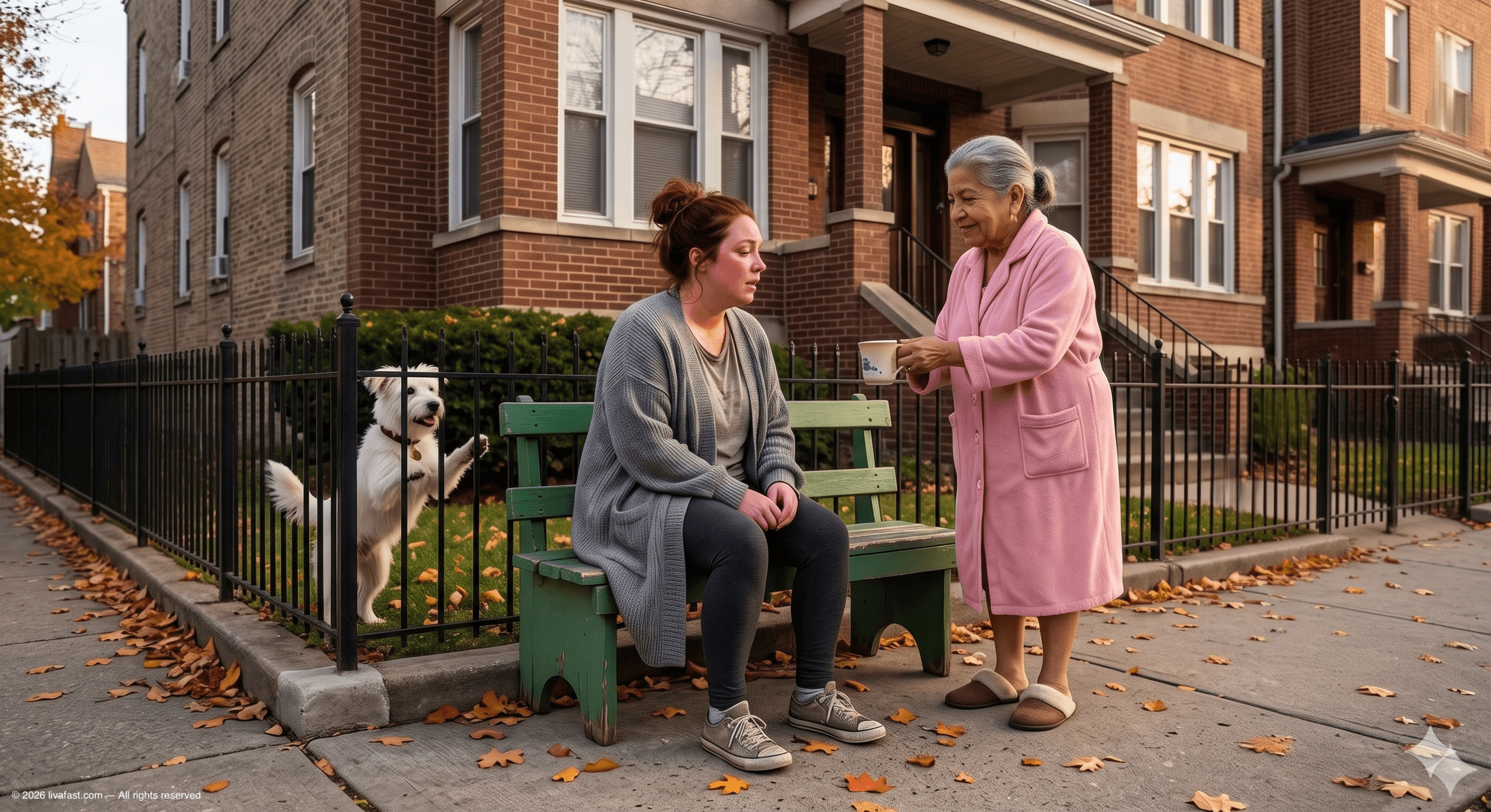
She stopped at a green-painted bench in front of a brick triple-decker that had a small, fenced front yard and, in the yard, a small white dog who came up to the fence and looked at her with the kind, undemanding attention of a dog who has been in a yard a long time.
"Hi," Ellie said to the dog.
The dog looked at her. The dog wagged once.
She sat on the bench. She breathed. Her face, she could feel, was warm. Her hands, in her lap, were warm. Her shoulders were stiff. Her right side was throbbing, but not burning, and she made herself notice the difference, because the difference was important.
The front door of the triple-decker opened. A small, gray-haired woman came out — round, brown-skinned, in a pink housecoat and slippers, with a coffee mug in one hand and a small can of dog food in the other.
"Pepe!" she called. The white dog turned and trotted, with the unbothered authority of a dog who has been called like that for years, toward the steps. Then the woman saw Ellie on the bench.
"¡Mi'ja!" she said. "Are you all right?"
"I'm fine. I'm just — I'm just sitting."
The woman came down the steps. She crossed the yard. She came out the gate, and she stood in front of Ellie on the bench, and she looked at her — not worriedly, not pityingly, but with the long, slow, evaluating look of a woman who had raised seven children and was not easily fooled.
"You walked," the woman said.
"Three blocks."
"Three blocks today, four tomorrow."
"That's the plan."
The woman extended the coffee mug. "Drink. Agua. Just water. I always carry water in this mug because the dog drinks out of cups and so do I now, that's what happens when you live alone too long."
Ellie laughed. She took the mug. She drank.
"I'm Beatriz," the woman said. "Beatriz Suarez. I live here forty-six years. I see people every day, walking, not walking, dragging themselves to that corner store for cigarettes, dragging themselves home. You are walking. You are doing the right thing."
"I'm Ellie. I live in the brown one on Maple."
"With the little girl. With the freckles. I see her sometimes."
"Sophie."
"Sophie."
Beatriz sat down on the bench next to her, with the small, careful movement of an older woman who knew her own joints. She put the can of dog food beside her on the bench. She did not say anything for a long moment.
"My husband had what you have," Beatriz said, finally. She was not looking at her. She was looking at the dog. "I am guessing. By the way you sat down. By the way you held your side. My Hector. Esteatosis hepática. They told us thirty years ago. The doctor was a fool. He said eat less, drink less, and that was all. There was no app. There was no nice young doctor who explained. Hector died at sixty-one. El hígado. I am sorry to tell you that. I am not telling you to scare you."
"Why are you telling me?"
Beatriz turned to her.
"Because you are sitting on my bench and you are forty years old and you have a little girl, and that is what Hector was when they told him, and that is who he had. And you are walking, and Hector did not walk. So I am telling you. Do you understand, mi'ja?"
Ellie's eyes filled.
"I understand."
"Good." Beatriz patted her knee. "Now. You drink the water. You sit a few minutes. You walk home. Slowly. Not like I see the joggers. Slowly. Tomorrow, you walk again. The day after, you walk again. You come past my house. I will be on the porch some mornings. I will wave. If you don't come, I will worry. ¿Entiendes?"
"Entiendo."
"You speak Spanish?"
"Two years in college. Not well."
"That is enough, mi'ja. That is plenty."
Ellie sat for another five minutes on the bench. The white dog watched her, calmly, from the porch. Beatriz went up the stairs and inside. When Ellie, finally, stood up — on legs that were stiff but no longer trembling — she walked the three blocks home a little slower than she had walked there, and she did not stop, and when she got to her own door, she leaned against it for a long minute with her eyes closed, and she felt — for the first time in years — the small, steady pleasure of a body that has been used and is now, gratefully, at rest.
Inside, Sophie was on the couch with her whale book.
"How was it?" Sophie asked.
"I sat on a bench."
"For how long?"
"Five minutes."
"Mom. That's not a walk."
"Peanut, that was a walk and a half."
Sophie considered this. "Okay," she said, generously. "Tomorrow you'll do better."
"I will."
That night, Ellie wrote into her notes app:
Day Two. Walked three blocks. Met Beatriz Suarez. Drank water. Fasting started 7:14 PM. Goal: 12 hours.
She did not yet know that Beatriz would, within six months, be teaching her to braise fish with green olives in a kitchen that smelled of orange peel and oregano. She did not yet know that the green bench would be, for the next year, the small, fixed star around which her walks would orbit. She only knew that she had walked, and she had been seen, and she had been welcomed, and that something in her body — something that had felt very alone for a very long time — was, tonight, less alone.
Track this in LivaFast
Your FIB-4 score updates automatically from your labs.