Chapter 11 · The App
A small ring on her phone. A timer that asks nothing but time.
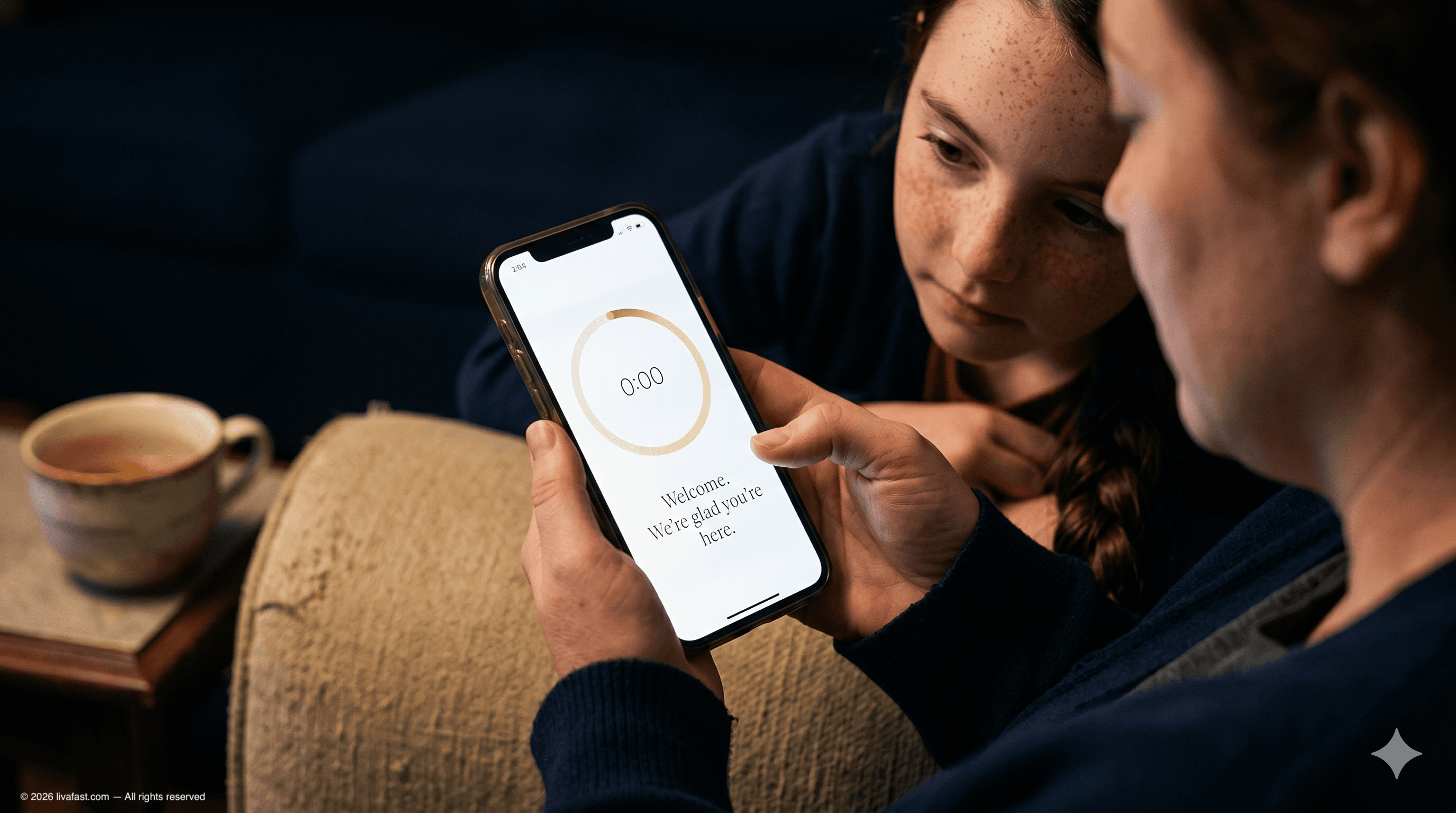
"Mom," Sophie said. "You're holding your phone like it might bite you."
It was Monday night. Ellie was sitting on the couch with the printout in her lap, the printout from Dr. Reyes's office, the one that had the name of the app in italics on the second page. She had read the printout four times. She had not, yet, downloaded the app. She had told herself she would do it after dinner. After dinner, she had told herself she would do it after the dishes. After the dishes, she had told herself she would do it after Sophie's bath.
It was eight-forty. Sophie was in pajamas, on the couch beside her, with her hair in a damp braid.
"Mom," Sophie said again. "Download it."
"I know, peanut."
"What are you scared of?"
Ellie considered the question. The answer, when she found it, was unflattering enough that she told the truth. "I'm scared," she said, "of being one of those people."
"Which people?"
"The kind of people who download apps for their problems."
Sophie blinked at her, with the mild, mature impatience of a fourth-grader whose mother was making no sense.
"Mom. Everybody downloads apps for their problems. I have a math app."
"Okay."
"Just download it."
Ellie downloaded it.
It opened with a soft chime — not a bright chime, not a marketing chime, the kind of unobtrusive sound a small, well-mannered guest makes when she enters a room. The first screen was clean. White background. A single line, set in a serif font:
Welcome. We're glad you're here.
She tapped through. There were questions. Your age. Your weight, if you'd like to share it. Any conditions you've been diagnosed with. Your goals. There was a checkbox for MASLD. There was a checkbox for fatty liver disease. She checked it, and the screen, gently, said:
Thank you for trusting us with that. Everything you enter stays on your device. Nothing about your health goes anywhere unless you choose to share it.
She read this twice.
She had been afraid, in the small, tired part of herself that read the news, that an app like this would want to sell her something. She had been afraid it would want her data. She had been afraid it would shame her — Eleanor, you are at risk! in a red banner, the way the bathroom scale she had thrown out two years ago used to flash OBESE on its little screen.
This app did not flash anything.
It asked her, gently, if she was already fasting, and at what hours, and how she was sleeping, and whether she was walking. It asked her if she would like to start a fasting timer now, or in the morning. She tapped now. It asked her — politely — what window she wanted to begin with, and offered her, as Dr. Reyes had, twelve hours.
She accepted twelve.
A small ring appeared on the screen. The ring was a soft, cream-colored line, very thin, beginning to fill — at twelve o'clock on the ring, where one would be — with a quiet golden light. There was a number in the center: 0:00.
Beneath the ring was a sentence.
You're in the first hour of your window. Most of what your liver does, it does quietly. Tonight, all you need to do is sleep.
Ellie stared at this sentence for a long moment.
Sophie, leaning over her shoulder, said, "What's that ring?"
"That's how long I've been fasting."
"It's pretty."
"It is pretty."
"Mom."
"Yeah."
"Will it tell you when you're done?"
"Yes."
"Like at breakfast."
"Like at breakfast."
Sophie nodded, satisfied. She picked up her whale book and read for another ten minutes and then went to bed. Ellie sat on the couch and tapped through the rest of the app. There was a section called Liver Score. There was a section called Sleep. There was a section called Movement. There was a section called Food, which was the simplest food log she had ever seen — no calories, no points, no shame. Just a small empty page. What did you eat today, and when? And, beneath that, in italics, Be honest. We are not going to tell anyone.
There was, also, a coach.
The coach did not have a face. The coach had a name — a small, soft name, Vita — and the coach asked Ellie, on the welcome screen, what she wanted help with. Ellie, on impulse, typed: I am scared.
The coach replied:
That's allowed. A diagnosis like this lands hard. The body you have today is the body that brought you here. Nothing about what comes next requires you to hate it. Tomorrow, your only job is to drink water in the morning, take a short walk if you can, and try to keep a twelve-hour fasting window. We'll go from there.
Ellie stared at this message. She read it three times. She had braced herself, for so many years, for the small, sharp voice of every health app she had ever briefly tried — You missed your goal! You are off track! Earn your treat! — that the absence of that voice almost undid her.
She typed: thank you.
The coach said: Sleep well, Eleanor. The ring will be here in the morning.
She turned the phone face-down. She brushed her teeth. She drank a glass of water. She got into bed. She lay in the dark, on her side, with her hand against her ribs, and she watched, in her mind, the small, golden, nearly imperceptible ring filling, hour by hour, while she did the only thing the app had asked of her.
She slept.
Track this in LivaFast
Your FIB-4 score updates automatically from your labs.