Chapter 21 · Theo at the Trail
A widower on a forest path. Two grown people, slowly, carefully.
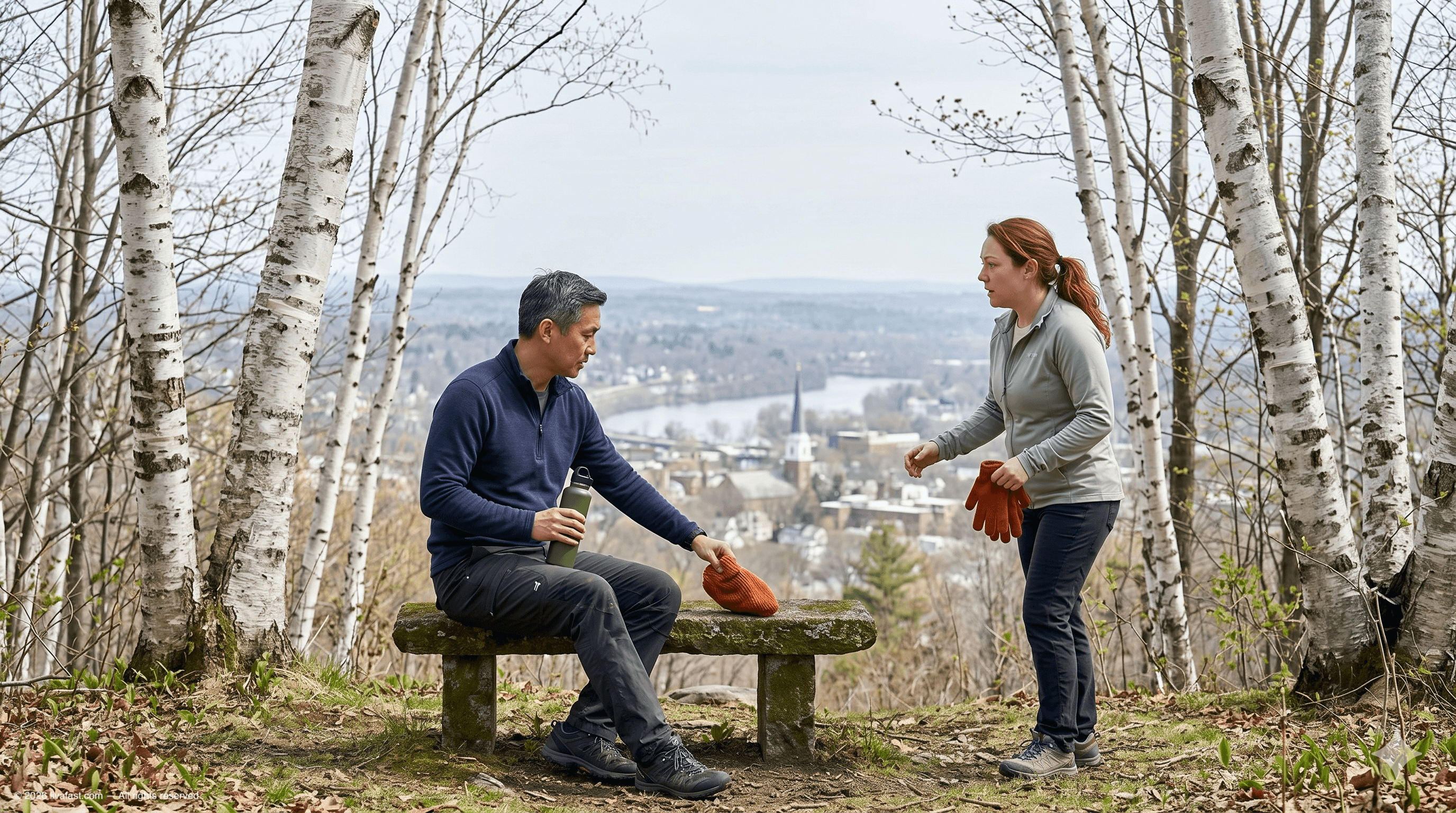
She did not, for a long time, walk in the woods.
She was, like many city women, a sidewalk walker. She walked the blocks. She walked the river path. She walked the bridge. She had, for years, kept herself away from the longer, untidier trails of the conservation land at the north edge of the city, because she had told herself, in the old life, that those trails are for serious people. Those trails are for runners. Those trails are for people in proper shoes. She had not, for many years, been a serious person.
In April, she went to the trails.
She went in proper shoes. She had, on Linh's insistence, finally bought a pair of trail-running sneakers — Marin, you are walking five miles a day, you need real shoes. She had bought a small, light backpack, and a steel water bottle, and a cheap pair of cotton gloves for the early mornings when, in April, the air still bit at her fingers. She had, in her backpack, a thermos of coffee, a banana, a cheese stick, and a folded paper map of the conservation trails.
The first trail was three miles. It looped around a pond. It rose, gently, through a stand of tall, white, peeling birches, and dipped, for a quarter mile, into a small valley of damp moss and old pines, and rose again, on a bare, sandy ridge, with a view down to the city below, where, on a clear morning, you could see the spire of the Unitarian church and the bright square of her own apartment building, six blocks east of the church, against the river.
She walked the loop in seventy-eight minutes. She stopped twice. She drank water. She felt — at the top of the ridge, with the wind in her hair — the small, surprising elation of a body that, two seasons ago, could not climb the auditorium stairs.
She walked the loop again the next Saturday. She walked it again the Saturday after that.
On the fourth Saturday, on the ridge, there was a man.
He was sitting on the small stone bench at the top of the ridge, drinking from a green metal water bottle, looking out over the city, and he had — Ellie noticed, with the kind of attention single mothers in their forties do not always allow themselves to admit they have — the kind of stillness she had not seen often in men. He was not on a phone. He was not, with his eyes, doing anything. He was sitting, and looking, and the way his shoulders rested against the back of the bench — with the particular looseness of a person who has run a long way and let his body, finally, set down the running — made him look, to Ellie, like a man at a small private peace.
She would have walked past him.
She did not walk past him because, as she came up the last few feet of the ridge, the wind turned, and her hat blew off her head and across the path and, with mild, comic predictability, into the bench beside him.
He picked it up. He turned. He held it out.
"Yours," he said.
"Mine," she said.
"There's a leaf in it."
"There's always a leaf in it."
He laughed. It was a small, quiet, rumbling laugh, the kind a person makes when he is not, by habit, a great laugher. He had — Ellie saw, when she stepped closer — a face that looked older than it was. Not old. Lived in. Forty-something. Black hair beginning, at the temples, to thread with a thin gray. Eyes that were dark and tired and kind.
"You walking the loop?"
"I'm walking the loop. Slowly."
"Me too."
"You don't look like you walk it slowly."
"Today, I am. My knees. I'm a physical therapist. I tell my own patients to slow down. Today the trail is telling me."
"Shame, if a physical therapist had to listen to his own advice."
He laughed again. He stood up. He extended his hand.
"Theo Chen."
"Ellie Marin."
They began, without quite deciding to, to walk together. He kept his pace, which was a slower pace than it would otherwise have been, with hers. She did not, at first, notice this. They walked in companionable silence for the first quarter-mile. The trail dipped, and turned, and rose, and at the small wooden footbridge over a creek, they paused, side by side, and watched the water.
"You walk a lot?" he said.
"Six months ago, no. Today, yes."
"What changed?"
She told him. She did not, on the trail, tell him the long version — she told him the short version, the version one tells a stranger one has just met. Diagnosis. Liver. I had to change my life. I am changing my life. She did not, especially, soften it, and she watched his face, while she said it, for the small, retreating reaction one sometimes gets from men one tells one's true story to. He did not retreat. His face, instead, softened.
"My wife," he said.
"Yes."
"My wife was diagnosed with pancreatic cancer two years ago. Different story. Same family of stories. The kind of story that makes you reorganize what your life is for."
"I'm sorry."
"She died last May."
"Theo. I'm sorry."
He nodded. He did not, this time, look at her. He looked at the creek.
"I started running again three months ago. I stopped, for a long time. I started again because — because I had to do something, with my body, that was, I guess, mine, and not hers, and not the cancer's, and not the funeral's. I do not love it. But I do not hate it. I do it now, because if I do not do it, I sit in the apartment, and I look at her chair."
"Yes."
"What's the app on your wrist?"
She looked down. She had been wearing, for two months, the small smartwatch she had bought because the app integrated with it, and because tracking her resting heart rate — once a week, the way she had once tracked her weight — had begun to give her, in a quiet way, a daily portrait of the body she was rebuilding.
"It's a fasting timer. And a sleep tracker. And a — it's a thing I look at."
"Does it help."
"It helps. Yeah."
"Mae had one."
"Mae?"
"My wife."
"Oh."
"It tracked her chemo days. Toward the end."
"Theo —"
"I'm not — I'm not saying that to — " He paused. "I'm saying it because it's the first thing I thought of. I haven't said her name out loud in two weeks. She's been the loudest thing in my head since she died, and I have, in the last week, started not saying her name out loud, because there is no one to say it to. And I'm saying it now, on a trail, to a stranger, and I'm sorry."
"Don't be sorry."
"You don't know me."
"I don't. Say her name."
"Mae," he said.
"Mae," Ellie said.
They walked the rest of the loop together. They did not, in any large way, talk about each other's pain. They talked about other things. He told her, very quickly, about his work — he was a physical therapist, he ran his own practice, he was forty-four — and she told him, in return, that she illustrated children's books, and that she had a daughter, and that she had a brother who had begun, in February, to lose weight himself, and to walk, and that she had a mother who was difficult, and that her father had died young.
At the trailhead, where their cars were, he turned to her. He did not, she noticed, do the awkward, half-leaning thing that men often did at the end of conversations. He looked at her, simply.
"Ellie Marin."
"Theo Chen."
"I walk the loop most Saturdays."
"I walk it most Saturdays."
"I wasn't going to say anything else."
"I know."
"I'm — I'm not in a place where I can say much else."
"I know."
"But if I see you up here next Saturday."
"You'll see me."
He nodded, once. He got into his car. He waved, briefly, through the windshield. He drove away.
Ellie stood in the parking lot for a moment with her hands in her pockets. The wind, in April, smelled of wet earth and small, green things pushing up through it. She walked to her car. She drove home.
She did not, that night, write about Theo in the app's journal. She wrote, instead, only:
Walked the conservation loop for the fourth time. Pace continues to improve. Saw a creek I had not seen before. Slept well.
But she lay in bed, in the new mattress, in the dark, and she said his name once, quietly, to the ceiling — Theo — to test it, to see what it sounded like in her own mouth — and she found that it sounded like a thing she had not, in eight years, said out loud.
Then she said, Mae. Because his wife's name, also, deserved a voice.
Then she slept.
Track this in LivaFast
Your FIB-4 score updates automatically from your labs.