Chapter 20 · The Mattress
She buys a real bed. Sleep, that other invisible medicine.
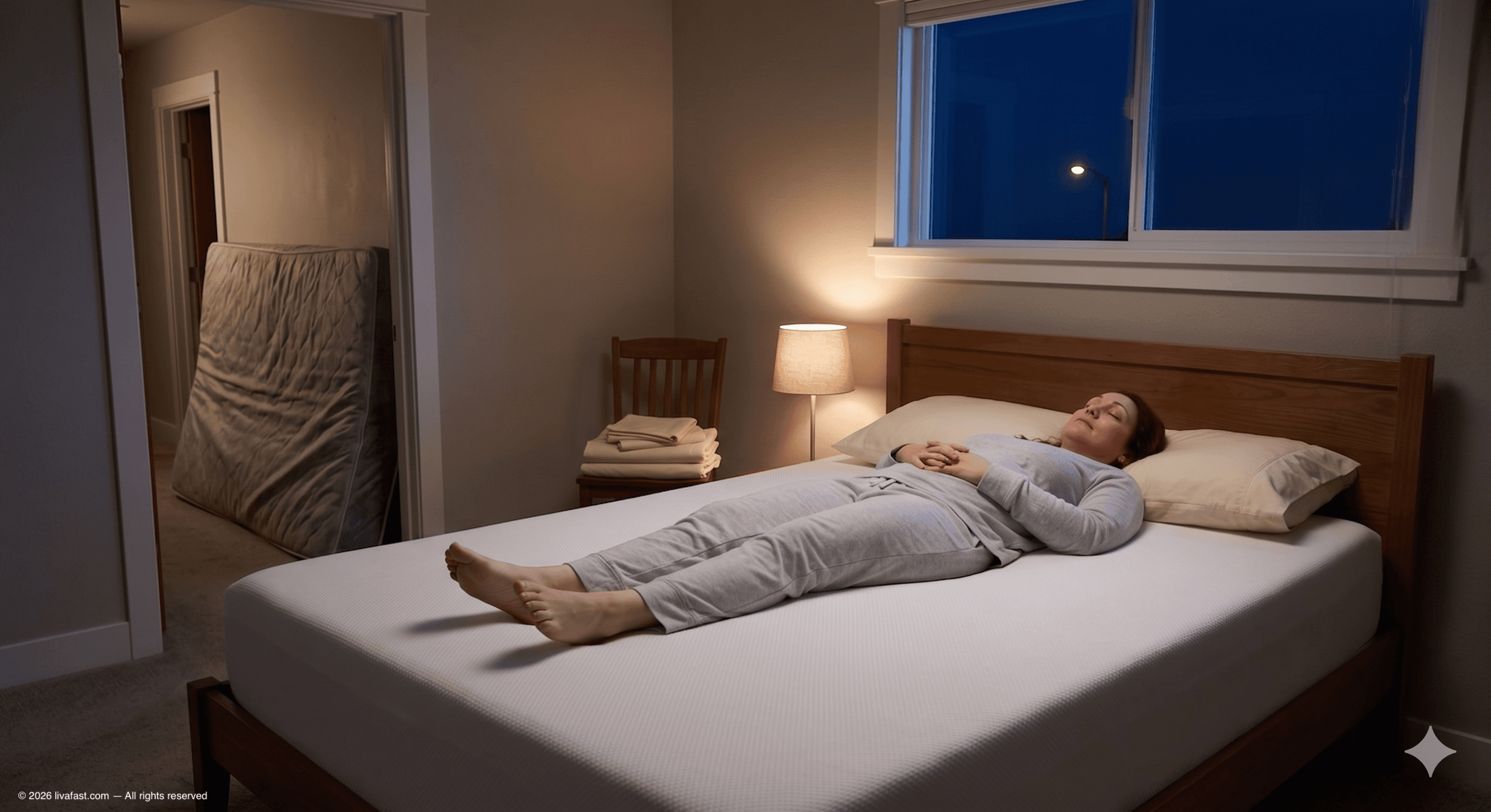
The mattress was sixteen years old.
It was, in fact, the mattress that David had bought, before Sophie, when they had been newlyweds in their first apartment in Davis Square. It was a queen-sized, mid-priced, faintly off-white slab of foam that had, over sixteen years, taken — like a fingerprint in clay — the shape of the woman who had slept on the right side of it.
When David had left, the mattress had stayed. There had been money for it. There had been time for it. Ellie had simply, in the way of people who are tired in ways they cannot explain, never replaced it. She had bought new sheets. She had bought new pillows. She had not, in eight years of single motherhood, bought a new bed.
The app, in February, in its quiet way, had begun to ask her about her sleep.
Her sleep had improved. From five hours and forty-eight minutes of restless, fragmented sleep, in November, to seven hours and twenty-two minutes of better, but still imperfect, sleep, in February. The app, in the sleep section, gently pointed out that her overnight heart rate was higher than it should be — which is sometimes, the coach said, a sign of an environmental issue, not a physiological one — and it suggested, with the patience of a friend, that she look at her sleep environment.
She looked.
The room was clean. The temperature was fine. The room was dark. The room was, she realized, with sudden, retrospective clarity, sleeping on a piece of foam that was two years older than her ten-year-old.
She shopped on a Tuesday night.
The mattress store on Route 9 was a strange, brightly-lit cathedral of beds, with a tired salesman named Don who spent, at first, ten minutes trying to sell her something twice the size she needed. When she said, firmly, that she wanted a queen, and that she wanted a firm one, and that she wanted to lie down on it for ten minutes by herself without being talked at, Don, who had, over twenty years in the business, learned to recognize a woman who had made a decision, gave her a small, respectful nod and left her alone.
She lay on the bed.
It was firm. It supported her hips. It did not, like the old one, swallow her into a soft, accumulated valley. She lay with her hands on her belly, and she looked at the ceiling — a drop-tile ceiling with fluorescent lights — and she thought, quite suddenly, I deserve this.
She had not, in eight years, allowed herself a thought of that exact shape.
She bought the mattress. They delivered it on Saturday. Two large, polite men carried it up the stairs. They took the old one. The old one — when the men flipped it onto its side, in the hallway, to maneuver it through the doorway — was misshapen. It bowed in the middle. It bowed where, for sixteen years, an ordinary woman's body had pressed against it night after night. It looked, Ellie thought, embarrassed.
The new mattress sat in the bedroom, white, square, unmarked.
That night, when Sophie was asleep, Ellie lay down on it. She turned off the lamp.
The room, in the dark, was different. She could not have said, at first, how. She lay still. She listened to her own breathing.
Then she understood. The mattress did not move. The mattress did not creak. The mattress did not, with the small, dry sound of foam fatigue, register her every shift. The mattress was quiet.
She slept eight hours and forty-one minutes.
The app, in the morning, said: You slept the longest you have slept in the period we have been tracking. We hope it felt good.
It had. It had felt, in fact, like something she had been unknowingly chasing for years — the simple, unremarkable, ordinary thing of being asleep in a way her body had been politely insisting it deserved.
She bought a real pillow the next week. She hung blackout curtains the week after. She moved the alarm clock to the dresser, instead of the bedside table, where its small green numbers had been quietly throwing themselves against the wall for almost a decade.
By the end of March, her resting heart rate, in the app, had dropped from seventy-eight to sixty-six. Her morning fasted glucose, on the second test, was eighty-nine.
Dr. Reyes, in their three-month follow-up, looked at the new numbers and, again, did the small, contained laugh of a doctor who is not, by training, allowed to celebrate.
"Eleanor."
"Yes."
"Whatever you are doing."
"Yes."
"Keep doing it."
"I will."
"And Eleanor."
"Yes."
"I'm going to schedule your six-month ultrasound in six weeks. We're going to look at your liver again. I want to see the picture, not just the numbers. Are you ready?"
"I'm ready."
She drove home with her hand resting, lightly, on her own ribs. Beneath her hand, the small organ that had — for so many months — been the silent center of her life, was, now, just an organ. Quiet. Working. Healing. Almost, on some days, forgotten, in the busy, ordinary way that healthy bodies forget themselves.
She did not, for a long time, drive past the drive-through and feel the pull. She drove past, that day, and felt, instead, only the small, distant memory of having once been a woman who had felt the pull. She turned on the radio. She drove home. She picked up Sophie. She made dinner. She walked, after, with her daughter, four blocks to the river and four blocks back, in the long blue dusk of a March evening, while above them, the maples — the same maples that, in October, had been throwing off their leaves like a person undressing for bed — were beginning to push out the small, hard, green-pink buds of a year that, this time, she was going to walk out into.
Track this in LivaFast
Your FIB-4 score updates automatically from your labs.