Chapter 19 · The Plateau
The scale stops. The liver score does not. A lesson in what to measure.
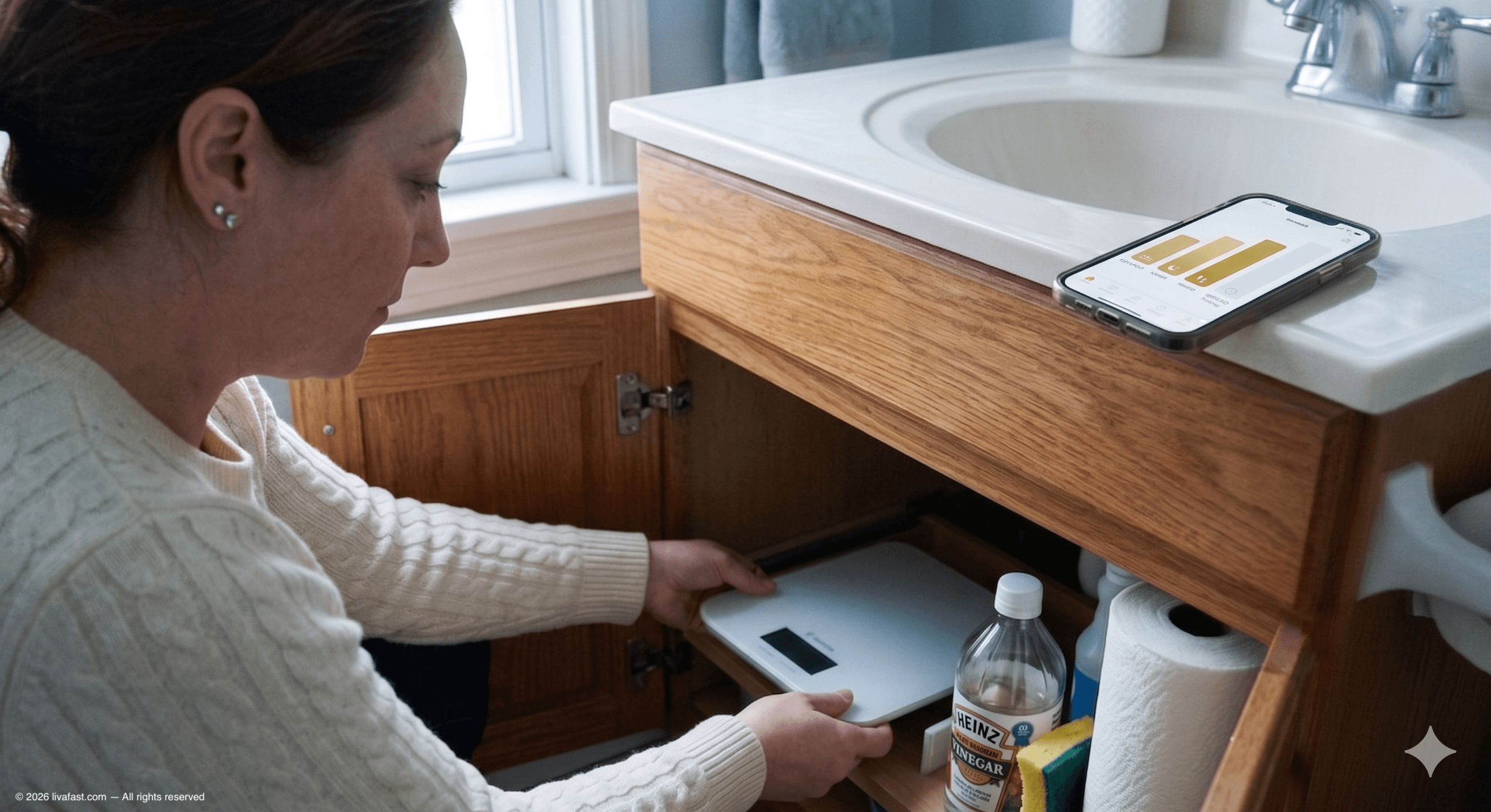
The scale stopped moving in February.
She had not, in the new life, weighed herself often. She had bought a digital scale in the second month — a small, plain one, the kind that did not flash judgments — and had put it on the bathroom floor, and had agreed with herself, in the company of the app's coach, that she would step on it once a week, on a Saturday morning, before she ate. The number had moved. Slowly, but it had moved. One pound a week, sometimes two, never more. By the end of January, she was one hundred and seventy-seven pounds, which was twenty-one pounds less than she had been when Sophie had played Solfeggietto.
In February, the number stopped.
It stopped, first, for one Saturday. Fine, she thought. Bodies fluctuate. It stopped for a second Saturday. All right. It stopped for a third, and a fourth, and on the fifth — when she stepped onto the scale on a cold, gray morning and the number read, again, 177.4 — something in her, something she had thought she had disarmed, lit up.
The voice was old. The voice was familiar. The voice belonged to every diet she had ever tried in her twenties. The voice said, See? It was never going to work. You are not the kind of person this works for. You are the kind of person who can lose twenty-one pounds and then, mysteriously, can lose no more, and you are going to live the rest of your life at one hundred and seventy-seven pounds, and your liver will get worse anyway, and Dr. Reyes will be sad, and you will, slowly, give up, and Sophie —
She turned the voice off.
She turned the voice off the way she had learned, slowly, in yoga class, to turn off the voice that told her she was too fat to be in a yoga class — by noticing it, by naming it, by, sometimes, saying out loud to the empty bathroom, I see you. Be quiet. I am not arguing with you today.
She got off the scale. She made a cup of coffee. She did not eat for another hour.
That afternoon, she opened the app. The Liver Score, on the home screen, sat at 78 — up from a starting value of 41, twelve weeks before. She tapped the screen. The coach, who had, by this point, learned the rough shape of her days, said:
The scale didn't move this week. It also didn't move last week, or the week before. Bodies plateau when they recalibrate. The Liver Score is still climbing. Want to talk about other markers?
She tapped yes.
Your fasting glucose has dropped from an average of 117 in November to 99 last week. Your average sleep has increased from 5h 48m to 7h 22m. Your daily steps have increased from 1,200 to 8,400. Your fasting window adherence is 94 percent. Eleanor: your liver is healing. Your body is repairing. Your weight is one number among many. We can put it away for a month if you want.
She tapped yes.
The scale, in the app, dimmed itself. The little badge on the home screen — the one that had been showing her weekly weight — vanished. In its place, gently, the four numbers that were moving. Glucose. Sleep. Steps. Fasting hours. The numbers her liver was actually paying attention to.
She thought, looking at this, that the app had quietly performed, on her panic, a small kind of surgery.
That night, she called Linh.
"Pham."
"Marin."
"My weight stopped."
"I know that voice."
"My weight has not moved in five weeks."
"How are your numbers?"
"My liver enzymes? Are coming down. My fasting glucose is normal, Linh."
"And how is your body."
"My body is — I think it's better. I sleep. I walk five miles. I went up the auditorium stairs at Sophie's school and I did not have to stop."
"So the scale stopped, and literally everything else is improving."
"Yes."
"Marin."
"Yes."
"Throw the scale away."
"Linh —"
"Throw it away. Marin. Wrap it in a trash bag. Take it to the dumpster. Walk away. If I had a nickel for every woman who has come to my class, three months in, looking and feeling and being better, and quit because of a scale —"
"I'm not quitting."
"You are not quitting because I am not letting you. Marin. The scale was a tool. It is not, anymore, a tool that helps you. Tools change. Throw it away."
She did not, that night, throw the scale away. But she put it under the bathroom sink, behind the cleaning supplies, where she would have to deliberately get on her knees and reach for it. She did not, all of February, get on her knees and reach for it.
In late February, on a Saturday, she stepped, for the first time in three weeks, into the kitchen at Beatriz's house. She had been there two days before for beans. Today she was there for something else.
"Mi'ja," Beatriz said, when she opened the door. "You are wearing — what is that. A new sweater?"
"An old sweater."
"It is not an old sweater."
"It is a sweater I have not been able to wear in four years."
Beatriz put both her hands on Ellie's shoulders. She looked at her, head to toe, in the way only a Cuban grandmother can look at someone — and she did not, Ellie noticed, look pleased in a way that was about thinness. She looked, instead, proud, in a way that was about carriage.
"You stand up straight, mi'ja. You did not stand up straight in November."
"I didn't?"
"You walked like a woman who was sorry. Today you do not walk that way. Bueno. Come in. Today we are doing fish."
She did fish. Beatriz had a small, pink-cheeked filet of red snapper from the Latin market on Pleasant Street, and she taught Ellie to score the skin in three diagonal lines, and to salt it ten minutes before cooking, and to lay it skin-side down in a screaming-hot pan, and to not move it, mi'ja, do not touch it, walk away, set the table, do not touch the fish.
The fish, when they ate it, was crisp on the bottom and white as a cloud above. They ate it with sautéed kale, and a small mound of brown rice, and a simple salad of orange slices and red onion and a single torn mint leaf each, dressed with olive oil.
That night, walking home, Ellie passed her own reflection in the window of the bookstore, in the early dark.
She stopped.
She looked.
The woman in the window was a woman she did not, at first, recognize. The woman was wearing the old sweater. The woman's hair was pulled back at the neck. The woman's posture — that was the thing, that was what Beatriz had seen — was the posture of a person who had been carrying something heavy for years and had set, at last, a corner of it down.
The woman in the window looked, Ellie thought, like she belonged to herself.
She did not, that night, write anything in the food log. She wrote, instead, in the journal section of the app — a section she had not used before — the longer thing.
I have been afraid, for a month, that the changes I was making had stopped. The scale was telling me one story. My body was telling me another. I think I have been listening to the scale for so long that I forgot the body had a voice. Tonight, walking past the bookstore, I heard the body. I am healing. I am not, yet, healed. But I am healing, and I am going to keep going.
The coach, beneath this, replied, simply: We hear you, too.
Track this in LivaFast
Your FIB-4 score updates automatically from your labs.