Chapter 18 · Sophie's Question
Mommy, are you going to die? — and the answer she finally trusts.
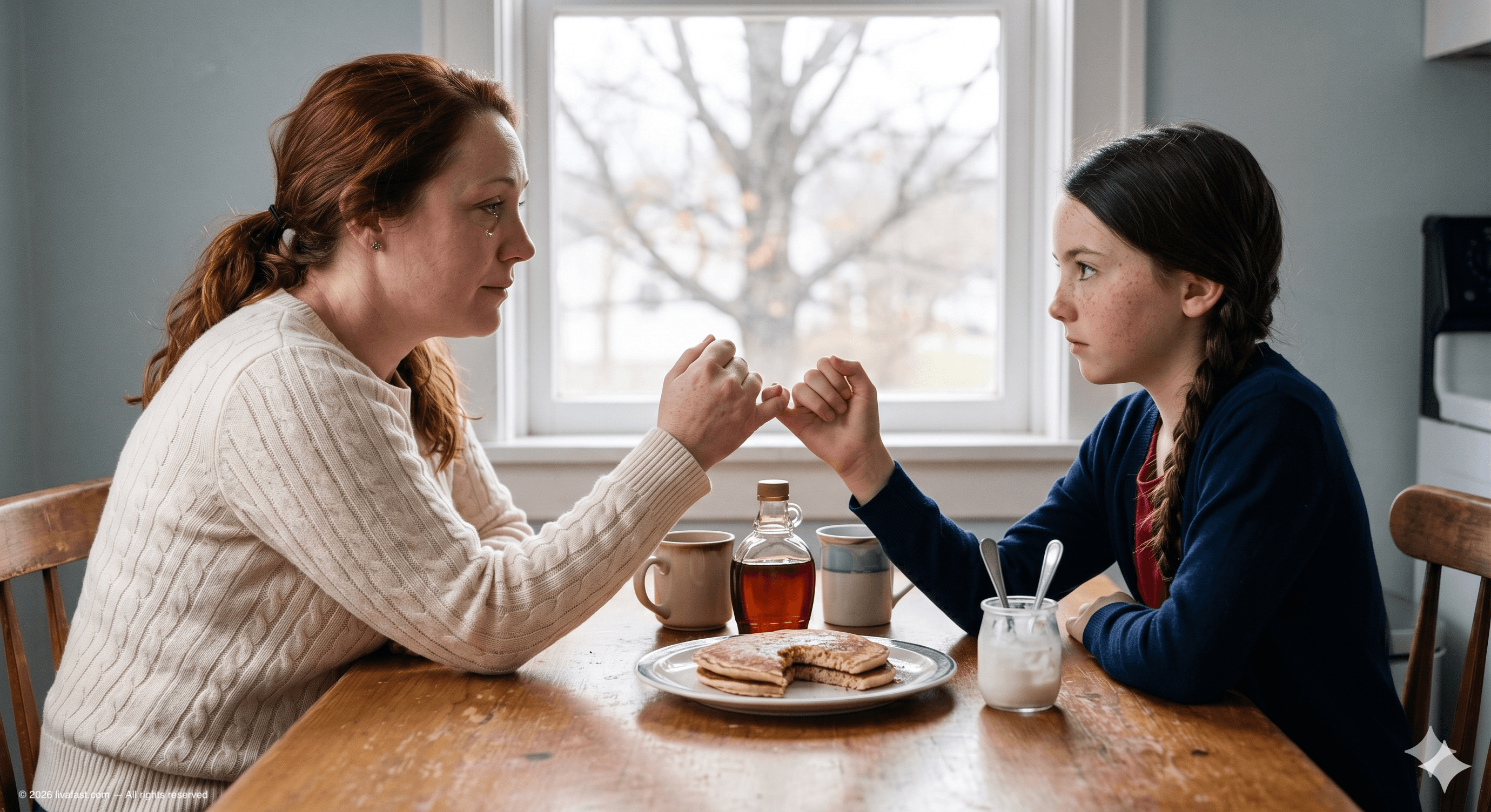
It came on a Sunday in November, at the small wooden table, in the gray light after a long rain.
They had been making pancakes, because Sunday was pancakes — that was the deal, that had always been the deal, even in the new life. Ellie made them with whole-wheat flour and a single small mashed banana for sweetness and a teaspoon of vanilla, and Sophie ate three of them with a careful, ceremonial drizzle of real maple syrup. Ellie ate two. Coffee. A small jar of plain Greek yogurt, between them. The maple was, outside the window, almost bare.
Sophie set her fork down.
"Mom."
"Yeah, peanut."
"Can I ask you a serious question."
Ellie set her fork down too. She had learned, in the past two months, to recognize this voice. It was Sophie's grown voice — the voice she used, increasingly, when she had been thinking about something for a long time and was, finally, ready to say it.
"Yes," Ellie said. "Always."
"When you went to the doctor — the first time — when you got the bad news —"
"Yes."
"— you said it was reversible."
"It is."
"You said you weren't going to die."
"I'm not."
Sophie, very seriously, looked at her mother. The freckles on her nose looked, in the gray light, like small punctuation marks. Her eyes — David's eyes, but in the past year more and more like her grandmother's, and one of these days Ellie would have to make peace with both of those facts — were full of the kind of fear that ten-year-olds, when they finally let it out, are unbearable about because they are unrehearsed.
"But you could have died."
"Peanut —"
"If you hadn't gone. If you hadn't walked, and emptied the kitchen, and — and — and — you could have died. You could have."
Ellie breathed.
"Yes," she said. "I could have. Eventually. Over time. If I had not gone, and not walked, and not changed — yes, peanut. The disease I have, if you do not turn it around, can become very serious. So, yes. Eventually. But I am here. And I went. And we are going to keep doing this. Okay?"
Sophie's eyes were, now, bright with tears. She did not let them fall.
"Mom."
"Yes, baby."
"How come you didn't go sooner?"
The question landed in the kitchen like a small, sharp rock thrown into a pond. The ripples moved out. Ellie did not, immediately, answer. She looked at her own hands, on the table, on the wooden table where they had eaten pancakes and salads and Beatriz's leftover beans, and she thought — with the slow, painful honesty that her daughter, again and again, was demanding of her — about the answer.
"Peanut. I was scared."
"Of the doctor?"
"Of what the doctor would say. Of having to change. Of finding out something I didn't want to know."
"That's silly."
"It's not silly, peanut. It's human. Adults are scared sometimes. And when adults are scared, they do a thing called avoiding. They pretend the scary thing isn't there."
"For how long?"
"Sometimes a long time."
"How long did you pretend?"
Ellie counted. She could not lie. She had decided, in the past two months, that she would not lie to her child about this disease, ever, even when the truth was unflattering.
"At least a year, peanut. Maybe two. Maybe three. I'd been tired and sore for a long time. I told myself it was nothing."
"Mom."
"Yes."
"You can't ever do that again."
"What do you mean."
"You can't pretend things again. About your body. Promise."
Ellie reached across the table. She took her daughter's small, sticky hand in hers. She held it.
"I promise, peanut. I will not pretend anything again."
"Pinky."
They linked pinkies.
There was a long silence in the kitchen. The radiator clanked. The dog upstairs barked once at a squirrel. Ellie watched her daughter's face — watched the way the fear, slowly, subsided in it, watched the way Sophie's small, careful relief replaced it — and felt, in herself, the strange, cold, clarifying realization of a parent who has, accidentally, taught her child a lesson she had been refusing to teach herself.
"Sophie."
"Yeah."
"I want you to know something, peanut. I am not getting better only because I am scared of dying. I am not getting better only because I want to not die before you grow up — although, of course, of course I do."
"Then why."
"I am getting better because I want to live. There's a difference."
Sophie thought about this.
"Like the bowhead whale," she said, finally.
"What about it."
"It doesn't, like, try not to die. It just lives for two hundred years."
"Peanut. I love you."
"I love you too, Mom."
They finished the pancakes. They washed the dishes together. Sophie went to her room to read. Ellie sat at the small wooden table with her second cup of coffee, and she watched, through the window, the bare maple at the corner, and she thought — I want to live. It was the first time, perhaps, that she had said it to herself in those exact words. Not: I do not want to die. The other thing. The harder thing. The greater thing.
I want to live.
She picked up her phone. She opened the app. In the food log, where she logged, every morning, what she had eaten and how she felt, she did not write a list of food. She wrote, in the small box, four words:
I want to live.
The coach replied: Then we will help you.
She put the phone down. The ring, on the home screen, was already filling. The day had begun.
Track this in LivaFast
Your FIB-4 score updates automatically from your labs.